“Churches and trains
They all look the same to me now
They shoot you some place
While we ache to come home somehow”
– Gregory Alan Isakov, Amsterdam
“Churches and trains
They all look the same to me now
They shoot you some place
While we ache to come home somehow”
– Gregory Alan Isakov, Amsterdam
Ojiyama Stadium, Otsu, Japan — Start of the Biwako Mainichi Marathon — March 5, 2017
In the audio, you can hear me say that 77 seconds (for the first 400) is “2:12:30 pace…”
It is actually about 2:14:30 pace. This miscalculation had amusing consequences later…
Morning
After almost two weeks in Japan… after the long travel, the adjustment to the ten-hour time difference, the efforts to maintain a familiar diet in an unfamiliar environment, the exploration of every turn on the course… finally it was time for Tyler to run the race that had been the focus all along.
The weather forecast was almost perfect for the 12:30 p.m. start: slightly overcast skies with temperatures in the mid-fifties (Fahrenheit), light winds out of the South, and low humidity. Later we would hear the Elite Athletes Coordinator say that it was the best weather he had seen for this race in 20 years.
The late start made for an unhurried morning. I had plenty of time to make myself breakfast in the Apartment, write a few emails, and pack everything I thought I might need for the day, before walking over to the hotel around 9 a.m.
Ten minutes later, I was in Tyler’s room, as he and Mariana prepared to check out. Tyler had already had his pre-race breakfast, had already been out for a 10-minute shakeout jog, and had already prepared and labeled all the bottles he would have out on the course. There was still plenty of time before we headed downstairs to wait for the 10:00 a.m. shuttle bus to the stadium where the race would start.
At the Stadium
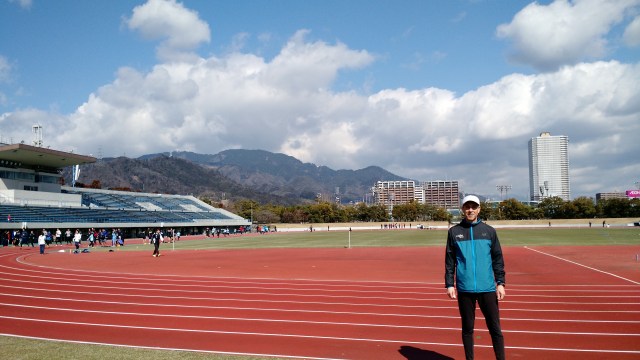
Arriving at Ojiyama stadium with over two hours before the race, we took a few moments to take it all in and snap some pictures on the track where the race would start and finish. Tyler and I had been in the stadium a week earlier when it was being used for a club track practice. Now there were numerous signs around the stadium with the names and logos of companies sponsoring the race, as well as IAAF banners and other decorations.
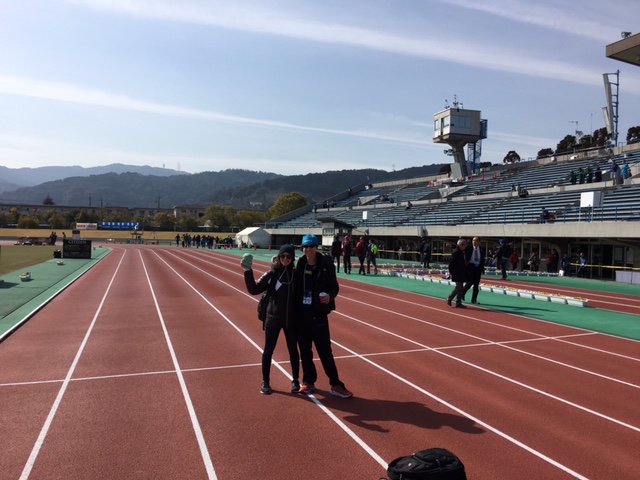
Mariana and Tyler, about two hours before the race.
There were a few spectators milling around as we showed our race credentials to enter the roped off area of the stadium. Tyler went with the other runners to check that his timing chip was working properly, and then we all headed to a temporary structure that had been set up to allow the athletes to relax before it was time to warmup and report to the start. There wasn’t too much to do, but I remember that Tyler and Mariana spent about 15 minutes reading aloud from their current literary obsession, David Foster Wallace’s Infinite Jest, while I scribbled thoughts in a notebook I had brought along for that purpose. Around us, a roomful of extremely capable marathon runners lay sprawled against the walls, trying to nap or listen to music through their earbuds — the calm before the storm.
At about 11:30 or maybe a little later, there came a point when suddenly we went from being a party of three to being a party of two. Without anyone really saying anything about it, Mariana and I realized it was time to leave. Tyler’s attitude had also changed, as he got up and prepared to begin his final pre-race routine. We exchanged a few words, wished him luck, and left him to his own devices.
Mariana and I went off to meet Tyler’s parents, who were coming on a train from Kyoto at around 11:45. For the next twenty minutes, we wandered among food vendors who had set up their tents in a park adjacent to the stadium. I was surprised that everyone else was hungry — Even when I’m not running, I find that I have little interest in food when there are races to be run. At about 12:10 we went back into the stadium and took seats where we could watch the runners assembling on the track below.
The Start
Tyler and I had had numerous talks about how the start was likely to play out. To begin with, we assumed that the top runners (and the pacemakers) would react to the gun by running their first lap of the track very fast. We also expected a lot of traffic, as the rest of the runners jockeyed for position. We guessed correctly that Tyler would start in the second row of runners, but we didn’t know what this might mean in terms of having to run in the outside lanes. We even went so far as to calculate the extra distance involved in running the 600 meters on the track in each of the Lanes.
When the gun went off, Tyler did well to keep his cool and find a comfortable spot in Lane 1. From the video, it appears that Tyler ran his first 400m in a very reasonable 77 seconds (5:09 mile pace). After all our worries about the start and the fear that he would need to sprint to avoid being trampled, it turned out that Tyler was able to run his target pace almost from the beginning, hitting the first kilometer in 3:15, actually a few seconds slower than his target 3:12 pace.
Watching the video, it appears that Tyler leaves the stadium in about 80th place.
Train Schedules and Running Schedules
I mentioned in a previous post that I spent a lot of time on Saturday planning our strategy to see Tyler out on the course. Without going into all the details, this strategy depended on the trains that ran reliably from Bessho station, about a 1-minute walk from the stadium, to Karahashi-mae station, about five mile away. From Karahashi-mae we could walk about 200m to intersect the course at about 10.5K, then walk another 200 meters across a bridge and see the runners for a second time at 19K as they headed up the other side of the lake. We could then wait at the same spot and see them on their return trip (23K), walk back across the bridge to see the runners at the 31.5K mark, and finally board a train back to Bessho to (maybe) catch the finish.
Needless to say, I had consulted all the train schedules and I had a complete plan, including options depending on how fast Tyler was running, and how confident we wanted to be about getting back to the finish on time. Tyler had responded to my plan by joking that he really ought to run the first 30K very fast, and then slow way down at the end to ensure we’d see him cross the line. No way, I said.
It was a minor flaw in the otherwise brilliant plan that the train we really wanted to take left Bessho station at precisely 12:34. The race started at 12:30, and, because we wanted to watch the first 600m in the stadium, we would have slightly less than two minutes to hustle out of the stadium to the station. We did our best, but as we approached, a train from the other direction came through, resulting in the gates across the track coming down. There was nothing we could do but watch from across the tracks as others boarded the 12:34 (running fans who had come up with similar schemes for seeing the race at multiple points), and the train left without us. It wasn’t a disaster, since another train would be along soon, but it resulted in us missing Tyler at the first checkpoint.
Other than that, the plan was good. We caught the next train at 12:42, took it all the way to
Karahashi-mae Station, and, since all of the runners had already passed by that point, continued across the bridge to wait for the leaders to arrive at the 19K mark.
We didn’t have long to wait. The leaders came by in a fairly large pack (running 2:06:30 pace!), with an even larger second pack about 30-40 seconds behind. Our prediction that the race would go out really fast, and that there would be many casualties, was coming true before our eyes. If Tyler ran evenly, he would be able to move up through the field as many of the fast starters tired.
After counting about 65 runners go by, we saw Tyler finally appear, looking strong and fairly comfortable.
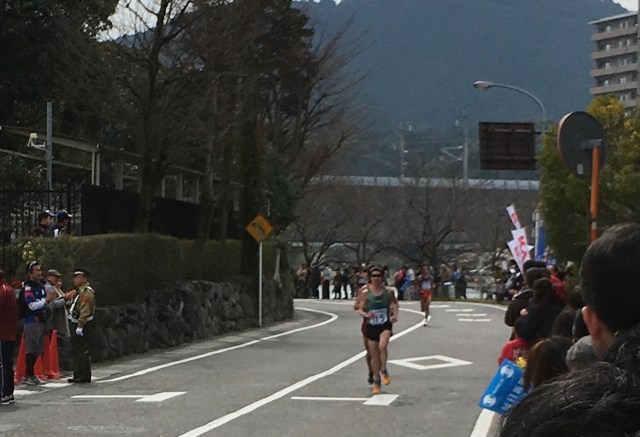
Tyler in ~65th place at 19K, about four minutes behind the leaders.
From where we stood, the runners were only 2K from the half marathon mark and the turnaround. This meant that we only had a few more minutes to wait before the leaders returned. When they did we could see that already the pack was splitting up, with only five runners at the front (including the two remaining pace makers). A few minutes after that, Tyler came by. He was now in 58th. His progress moving up through the field had begun.

The lead pack at 23Km.
Headwinds
In discussing our race-viewing plans with Tyler’s parents, they had expressed a strong desire to see the finish. As a result, we had made the decision that they would take an earlier train back to the stadium, ensuring they would arrive in plenty of time to see Tyler, as well as the leaders, circle the track one and a half times before crossing the line.
Tyler had specifically requested that I remain at the 31K mark, and so I was prepared to miss seeing him finish. Thus, I was waiting alone on the side of the road when I spotted him for the third time, only 7 miles from the finish.
My first impression was that he looked really good. He was still running his goal pace, maybe even a little faster, and he looked far better than any of the runners near him. I told him he was in 41st place, and that there would be “carnage” up the road as other runners reckoned with their fast early pace.
And then he was past me, flying up the road.
I sprinted to the train station and just managed to board a train that arrived 30 seconds after I had crossed the tracks. I stood in the crowded car, which seemed to be full of marathon spectators heading back to the stadium. Several of these people were streaming the race live on their phones, and so I was able to follow the action and hear that there were now just two Kenyans leading the race, that the top Japanese runner was about a minute behind.
I was also constantly checking my watch. As I got closer to Otsu, I made a quick calculation that my best bet to see Tyler again would be to get off one stop before Bessho, and then run to the final turn where the runners would enter the stadium. If I was right, that would give me one last chance to cheer for Tyler as he prepared for his final 600m on the track. It would also mean I wouldn’t have to fight through the thick crowds getting off at the stadium.
I executed my plan, exiting the train one stop early, and began running toward the stadium, but — oh no! — I didn’t recognize the street I was on. Did it actually lead where I hoped it would lead, or was I heading in the wrong direction? There was nothing to be done but to keep running, hoping at every turn that I would find my way out of the narrow labyrinth of houses, and emerge near that road where I knew the runners must pass.
Finally, after what seemed like a long time, but what my watch said was only four minutes, I came around a bend and saw that I was a block from the stadium. I ran up to where the crowd was massed near the entrance. It seemed that the first three runners had already entered the stadium and were on their final lap. As a Japanese runner came by, I asked another spectator — using gestures more than words — whether this was the fourth runner, and he confirmed that it was.
Now I had only to wait, counting the runners as they came by, and looking anxiously at my watch. After another period that seemed much longer than it was, I saw Tyler approaching. I knew that he had slowed, but he had also moved up into 24th place. I screamed at him some inarticulate words as he made the turn and headed up the slight ramp into the stadium and onto the track.
Bloody Feet
In those last 600 meters, Tyler caught two more runners before crossing the line with clock showing 2:16:06. That moved him up into 22nd place, and gave him his fastest time ever on a loop course, only 14 seconds off his PR that he set on the downhill, point-to-point Hudson Mohawk course in the Fall of 2016.
He had slowed over those final kilometers, but so had everyone else. Poring over his splits later, we would realize that he had run his last 7K as fast as the leaders, who, after running 2:06:30 pace through 30K, hadn’t even broken 2:09.
Contradicting the weather forecast, a significant headwind had faced the runners over those last 7K. Tyler himself had been on 2:15 pace at 35K, but lost a minute, despite catching so many people. He certainly didn’t let up at all, running his last 400 in about 75 seconds, two seconds faster than he had run the first 400 over two hours earlier.
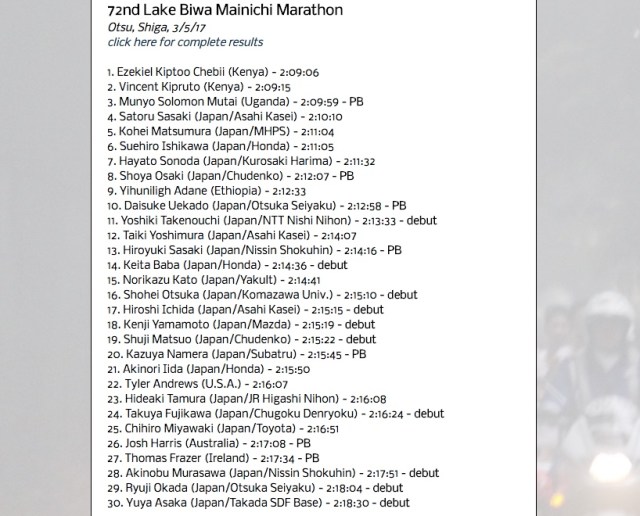
Tyler, 22nd in 2:16:07, his fastest time on a loop course.
The depth of the Japanese field — only one week after Tokyo! — is astonishing.
Having finished and found Mariana and his parents, Tyler finally began to reveal how much he had suffered in those final kilometers. He had the classic marathon finisher’s limp, as he hobbled over to where his bags and warm clothes were waiting. He told me his feet had started hurting early in the race, and that they were on fire by the end. At some point he took off his shoes to reveal bloody blisters.
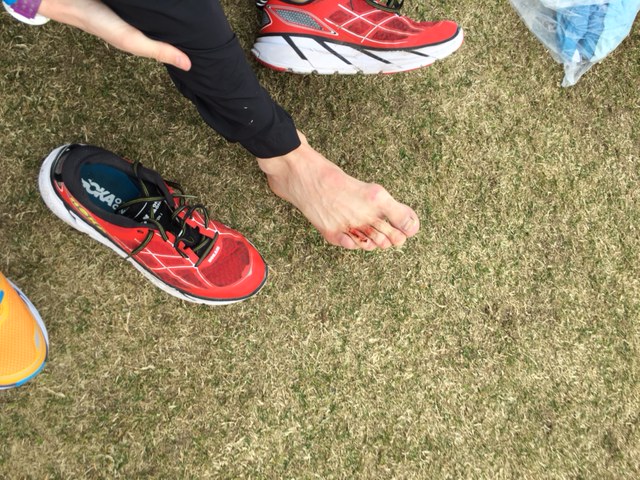
We made a slow, painful walk over to the medical building to have his blisters disinfected and dressed, and then rejoined his family for subdued congratulations.
Why subdues? It would turn out later that Mariana had heard my earlier comment about 2:12 pace — or perhaps had heard that Tyler wanted to run 3:12 pace (per kilometer) — and had got it into her head that Tyler would be disappointed by anything slower than 2:12, and certainly by a 2:16. In retrospect, it was pretty funny that Tyler’s parents were trying really hard to be supportive, assuming they needed to console their son, who had just run a fantastic race and was pretty well pleased with himself.
The next few hours were a slow recovery. Tyler, Mariana, and I took the shuttle bus back to the hotel, where we (mostly Mariana and I) snacked on food provided by race organizers. We said our good-byes and thank-you’s to the race personnel and the athlete rep who had helped Tyler and me since we had arrived almost a week earlier, hailed a taxi to take our crippled runner back to the apartment, and listened to him yell as he inflicted an ice bath on himself.
That evening we would splurge on another taxi to take us to Kyoto, where we would relive and celebrate Tyler’s race at a popular Japanese chain restaurant, joining Tyler’s parents and the same couple who had given Tyler and me a tour of the course several days earlier.
For the first time in a long while, none of us worried about what we were eating and drinking.

Elite athlete interviews prior to Saturday’s technical meeting for foreign athletes
I suspect that some of my readers — those who have patiently endured my travelogue so far — have not been distracted, nor have they forgotten that the reason I was in Japan in the first place was to support Tyler as he prepared to run a highly competitive marathon against a strong international field. These readers might allow that taking trains all the way to Tokyo and back to broaden the mind was well and good, but perhaps I should be giving my full attention to the upcoming race?
Indeed, that notion had occurred to me, too. So from Friday evening when I returned to Otsu after a full day of travel, I stopped being a tourist and all my thoughts turned to final preparations for Sunday. Continue reading

Panoramic view of Tokyo from Tokyo Skytree (Wikipedia)
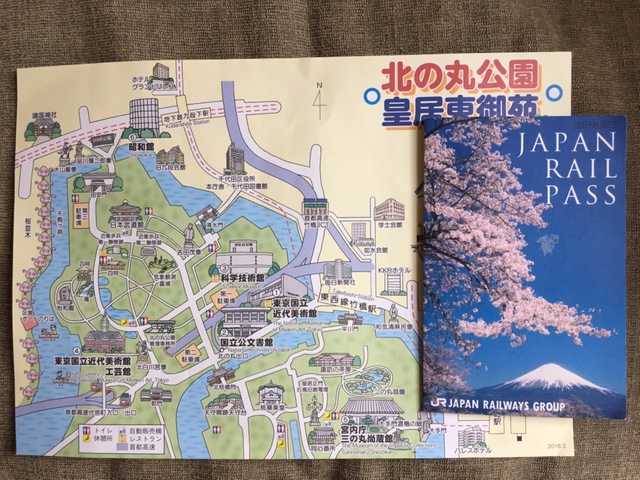
In retrospect, I’m really glad I decided to purchase a Japan rail pass. That document, which is sold only to foreign tourists on temporary visits to the country, offers nearly unlimited travel on the country’s spectacularly efficient train network. The pass encouraged me to explore and travel in a way I never would have had I been forced to pay each fare required to ride the fast trains to Hiroshima or Tokyo. And with it in my possession, almost nothing separated the thought – “You know, I could take the Shinkansen to Tokyo and back some day” – from the execution of the action.
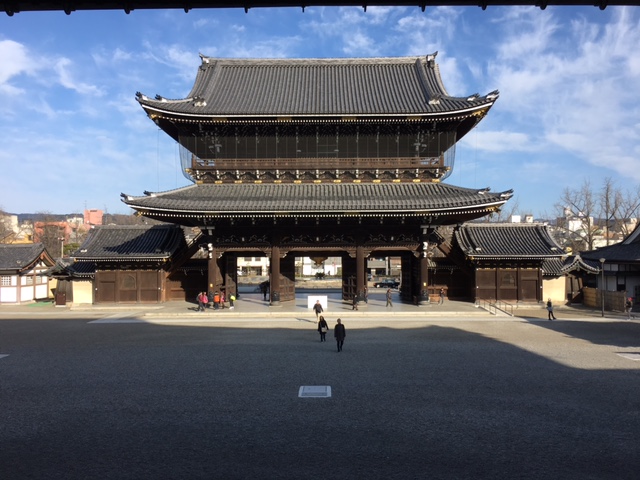
Gate at Nishi Hongan-ji temple, central Kyoto
Ah, Kyoto, city of temples and trains, ancient capital city and elegant modern metropolis, surrounded on three sides by mountains and monks; home to three million strangers and Samaritan to one stressed-out American traveler; destination of my first train journey in Japan, beating heart of all my travels from which I departed and to which I returned again and again before taking my final leave. Continue reading
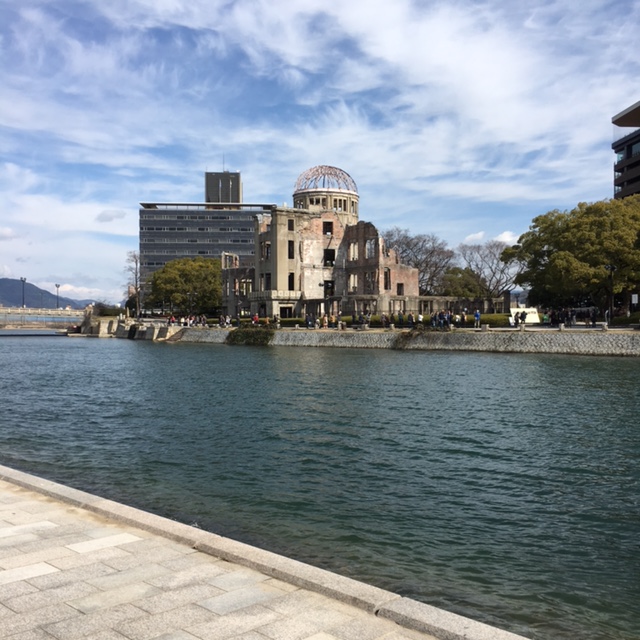
The former Hiroshima Prefectural Commercial Exhibition Hall, designed by Czech architect Jan Letzel, and completed in April 1915. The shell of the building is now known as “The Atomic Dome.” Continue reading
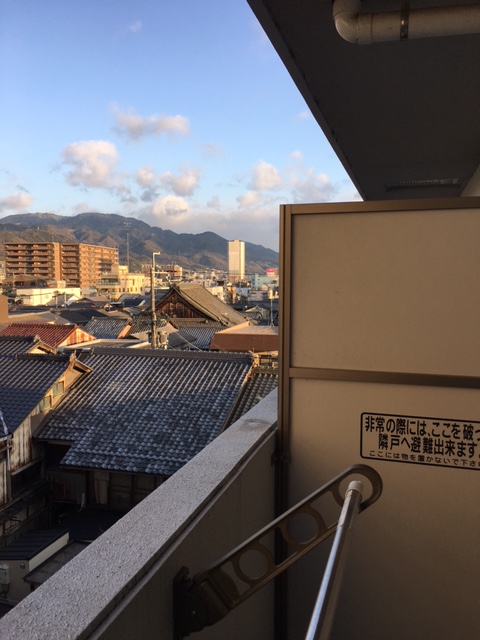
The morning sun shines in Otsu.
(The sign says: “In case of emergency, break through here and you can evacuate next door.”)
Friday, February 24 – finally, the sun came up bright and much more cheerful in Otsu.
From the balcony of our apartment, we could see mountains rising above the crazy quilt of rooftops below. I was hungry – I hadn’t eaten much over the last few days, and I had already eaten the only snacks I had brought with me. The previous afternoon, I had eaten some of Tyler’s stash of carbohydrates that he was saving for his carbo-loading the following week, but he had gently reminded me that I would need to find my own calories. He did let me “borrow” a banana, though. I also had some coffee, although there was no sugar in the apartment, so it didn’t do much to sate my appetite. With one thing and another, it was about 10 a.m. before I managed to get my running stuff on and get out the door with a plan to head down to the Lake and along the shore for a few miles.
With all that had happened the previous week – leaving my job, taking to my bed with illness, and then traveling for 30 hours, I hadn’t run a step in over a week, and it felt like it. It was less than half a mile to the lakefront from the apartment, but I struggled right away with heavy legs and an ache in my lungs that might have been illness or might have been the normal way lungs feel when you haven’t used them properly for so long. “Remember this, and never make fun of non-runners again,” I thought to myself.
Thankfully, there were plenty of sights to distract me along the lakefront. There was a large riverboat, the “Michigan,” docked at a pier and ready for excursions. It was a strange sight here, as it would have looked completely at home chugging down the Mississippi River on its way to New Orleans. There was the ten-story Biwako Hotel, which I knew was the host hotel for the Marathon, there were fallow gardens and amphitheaters along the broad brick promenade the stretched away to the South.
But most impressive of all was the Lake itself. At 63 kilometers long and 23 miles across at its widest point, Lake Biwa is the largest freshwater lake in Japan, and it is a spectacular sight. The Lake is surrounded by mountains, many of them snow-capped despite the relatively mild climate of this part of Japan. Otsu (“big harbor,” in Japanese) is located at the Southwest corner of the lake, and hosts boat races and other events during warmer months of the year.
The Marathon course would start at Ojiyama stadium, a few miles away. The first 600m would be on the track and then, after briefly heading North, the course would turn South onto a highway that followed the lake shore until the 15Km mark before crossing a bridge and heading North for another 6Km on the other side to the turnaround. The second half of the race would be the first half in reverse, including a final 600m on the track.
I finished up my run, arriving back at the apartment, where I spent a fair amount of time trying to figure out how to take a shower. The arrangement of toilet, sink, shower, and bath, was significantly different than an American bathroom. For one thing, the toilet is not in the same room as the sink/shower/bath. I believe this is true in most Japanese homes, although I noted later than Japanese hotels catering to Western visitors have no issue co-locating toilet and bath in the same general area. The second thing I noticed is that even this tiny, tiny apartment had a bathtub, although it was very narrow and deep. It took me a few moments to realize that the “room” that contained the tub had its own drain, and that it was for showering, leaving the bathtub for bathing only.
After my shower, Tyler and I set off to find a store where we could buy a few things for the apartment, including another mattress, and food. I hadn’t had much for breakfast, and I was really starting to miss food. (It occurred to me at some point, that maybe one of the reasons that I’m not a good traveler is that I too often ignore the need for food until it’s the only thing I’m thinking about. It’s hard to be delighted by a new place on an empty stomach. But I digress.)
Perhaps it would be interesting to describe Japanese department stores, or speculate on why it seems to be impossible to buy a loaf of bread with crusts in Japan (what happens to all those crusts?), but I fear it would become tedious. So let me summarize the rest of the afternoon by saying that we found a good, cheap mattress for my bed, found food that would keep me alive for a couple more days, took a taxi with our purchases back from the store (I gave the address in Japanese.. and the driver actually took us fairly close to where we wanted to go!), and struggled again to stay up until 9 p.m. I wasn’t nearly at 100% yet, but I had solved some practical problems.
The next day was even nicer than the one before. And I felt a little better, too, although still not 100%. Sleeping on a better mattress had helped, and breakfast helped, too. With these things taken care of, the project for the morning was to visit Ojiyama stadium, where the Marathon would begin and end a week from Sunday.
It was about 2K to the stadium, and we found an open entrance and went right in and beheld a gorgeous eight-lane track. In every corner of the track, groups of athletes were practicing their events. Distance runners were running long intervals. Sprinters were doing accelerations. Hurdlers were doing drills. Javelin throwers were throwing javelins. It was hard to tell, but it was either multiple track clubs, or a single track club that spanned a wide range of ages from grade-school age kids to high school or possibly even college. It was a familiar chaos, and immediately made me long for my own track team back in Concord.
Tyler was planning few 500s, just for some turnover work in advance of his final tuneup workout the next day. He also wanted me to find out whether the track would be open on Sunday, because ideally, he’d do that workout — a 10K run starting at marathon pace and ending considerably faster — on the track.
I asked the first person who looked knowledgeable whether the track was open on Sunday. He didn’t know, but accompanied me all the way to an office in the bowels of the stadium where I repeated my question to a very official looking man sitting behind a glass window. He listened, and then crossed his arms in front of him in an “X” and said (I think) “Tsukaenai!” — “(You) can’t use it.” Even if I wan’t sure of the word, I understood the meaning just fine. I went back to give Tyler the news.
By this time he was about ready to run his 500s, so I did what coaches do and prepared to read him splits. Around me, there were other coaches and assistants yelling out splits in Japanese. I suddenly had a moment of perspective, realizing that to everyone around us, Tyler and I were the foreign athlete and coach, conferring in our foreign language, as though we were hiding something. We might as well have been speaking Swahili.
The next day, Sunday morning, we returned to the vicinity of the stadium and discovered that the reason we couldn’t use the track was that the field was being used for a series of soccer matches. Fair enough. Tyler had scouted some other options, and in the end settled for a 730m loop around a large sandlot where baseball teams played. The first half of this loop actually was part of a larger 1K measured loop, so it had highly accurate 200m and 400m splits. Why didn’t he run the entire 1K loop 10 times? The latter half of the 1K had a section on bricks, and ever since the Doha 50K, Tyler has avoided bricks like they were kryptonite. He would rather do his tempo run by completing 14 laps of the 730m loop, 10.22K, with me providing splits every lap.
It was a beautiful morning, and it was very pleasant standing there, watching baseball players nearby, watching parents play with their kids in a playground about few dozen yards away. Every 2:20 I would give Tyler his splits, but that didn’t take much work.
Apparently Tyler was enjoying himself, too. He ran the first ~5K at his target marathon pace, and then immediately sped up. By the end he was flying, shirt off in the warm sun, and happy to be running fast on tapered legs. When it was all over, we reviewed the splits, noting that this was the fastest (and one of the easiest) of his “one-week-out” workouts — that is, workouts done one week from a big race. It was certainly a good sign, and boosted his confidence quite a bit. And the best thing — not a shred of jet lag.
We jogged back to the apartment well satisfied with the morning. Tyler was done with the hard work for the day, but I had other plans.
The previous day, I had taken possession of my precious Japan Rail Pass. The JR Pass would allow me to ride most of the national trains almost anywhere in the country. Having finally started feeling at home in Otsu, and still suffering from jet lag, I was going to travel again, this time to Hiroshima, 330 kilometers away to the Southwest.
After a quick shower, I packed my backpack, said good-bye to Tyler, and gave a wistful look at my comfy mattress, then headed out the door, heading for the train station.
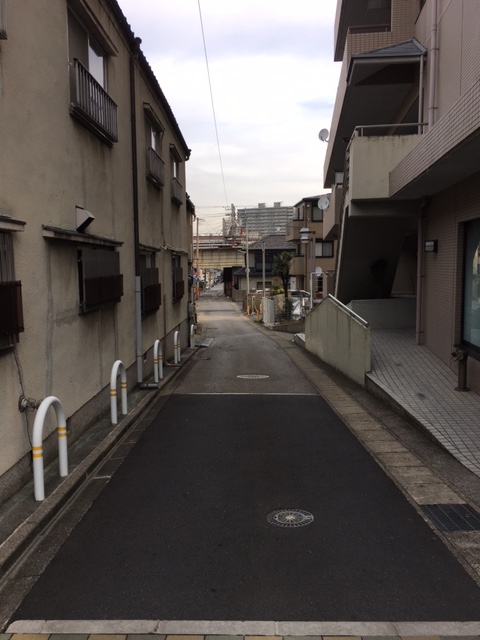
Finding my way through the narrow streets of Otsu.
In Japanese, there is a word — “semai” (狭い) – that means narrow, small, or confined, as in “a confined space,” “a narrow road,” etc. When I studied Japanese, I remember our teacher at one point sharing an aphorism that went, “Nihon wa, semai kuni desu,” which roughly translates to “Japan is a narrow country.”
When I arrived in Japan, it didn’t feel narrow; it felt enormous. Kansai International Airport seemed immense. The vast network of trains seemed overwhelming. The endless and uninterrupted landscape of two-story houses, imposing multi-story apartment buildings, and industrial yards made me feel like I was always a few miles from a major city center. Where was this “narrowness” that I had heard about?
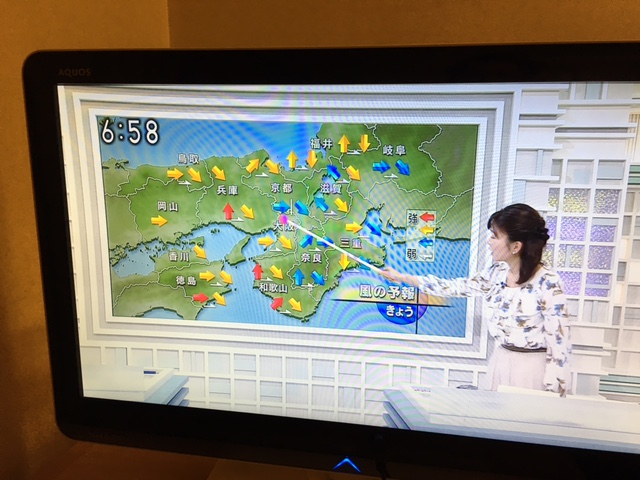
I don’t need the white weather report to tell me that it is gray and rainy in Osaka.
The first time I ran the Boston Marathon, I made many mistakes. Some of my mistakes were the kind of big, glaring mistakes that almost everyone makes – like going out too fast or not fueling properly – but some of my mistakes were small and subtle. One of the subtle mistakes I made was not having an end-to-end plan and focusing so much mental energy on the start and middle of the race – on getting to, and over, the hills — that I was ill-prepared for the final miles. The slog from Chestnut Hill into Boston were a weary and profoundly disappointing journey.
I think I might have made a similar mistake in my preparations for traveling to Japan; I had been so sick in the few days leading up to my first flight, that I had fallen into the trap of thinking that my greatest challenge would be getting on the plane and surviving that long day of flying. I focused all my mental energy on that immediate goal, and assumed that once I made it to my hotel in Osaka, I would be fine. It would turn out to be more complicated than that. Continue reading

Water spouts at the harbor welcome me to Otsu, on the shore of Lake Biwa.
Tyler tells me that we first started talking about Japan back in June 2016.
The original idea was for him to enter the Tokyo Marathon in late February. Thinking about his goals and schedule constraints for 2017 (and considering the generous travel allowance from his sponsor, Hoka), Tokyo seemed like a good option on all fronts.
However, it turns out that it’s very difficult for a non-Japanese runner to enter Tokyo without a world-class marathon time (i.e., sub-2:08). So, in the fall, when he needed to nail down his winter/spring racing schedule, he made a tweak to the plan and decided to run a different race in Japan, the Lake Biwa Mainichi Marathon on March 5, a mere week after Tokyo.
There was some talk about whether I might go, too, but with work and school, the possibility seemed remote. That situation changed when I decided to leave my job. What had seemed far-fetched suddenly seemed doable, and a rare chance to travel to a place I had never thought to see.
I haven’t seen many of Tyler’s races as a pro. I didn’t go to Doha either time he ran there, and I didn’t go to Houston or Hudson Mohawk or CIF or Burlington… But there was something different to me about the chance to accompany him on his trip to Japan. For one thing, it would be a chance to use the small amount of Japanese I had acquired years ago when studying the language with colleagues at Interleaf. For another thing, he was paying for the ticket (with miles he had acquired from traveling to other races).
The whole plan appeared to be perfect. I would leave my job, travel to Japan, and return just in time to begin coaching the spring Track season. I wouldn’t miss a beat. With some trepidation – the kind that always accompanies momentous decisions – in early January, I told Tyler to help me find a flight.
Alas, not quite perfect, as it turned out.
For one thing, my school had published the wrong start dates for track, and when they corrected their error, it became clear that the first week of the season would find me in Osaka. Oh well, I thought to myself, we can start a week late and not be too badly off.
The second shoe to drop was on Saturday when newly liberated from my work, I promptly caught a nasty virus. By Saturday afternoon, I noticed my head didn’t feel right and my throat was sore and scratchy. After nine hours of fitful sleep, I woke up feeling feverish. I took my temperature and it was over 101 F and climbing. I went back to bed and slept for another two hours, got up to make tea (which I kept forgetting to drink), took a nap on the couch, woke up for a second time and took my temperature again (101.7). The rest of the day and ensuing night I was either asleep or in a zombie state.
If there is a silver lining to falling seriously ill a few days before a long journey – perhaps the longest journey of one’s life – it might be the way that an illness slows down physical and mental activity to a crawl, affording ample opportunity to think.
Unfortunately, the only thing I could think about was how I was scheduled to board a flight in two days that would take me halfway around the world. In my fevered state, It seemed very hard to imagine it would really happen.
I left Boston on Tuesday morning, 2/21, and arrived in Osaka late Wednesday night. I fully intend to post updates about that trip and what I’ve seen and felt since, but my energy is still really low, so I beg a little indulgence.
Stay tuned…
 the runner eclectic