Two Marys

After Saturday’s New Balance Indoor Grand Prix meet, I had an idea for a blog post comparing the young Mary Cain to the young Mary Decker. Cain is a track prodigy, running world-class times at 17 and showing a mental toughness and ability to rise to the occasion that makes her a celebrity in a sport that doesn’t have many. Back in the early 1970s, Decker was even more of a prodigy, at age 14 already the owner of a world indoor record and a victory in the US vs. USSR meet. One of the top 800 runners in the U.S., she might have gone to the 1972 Olympics in Munich except she didn’t meet the age requirement.

Since Mary Decker (later Mary Slaney) would go on to become perhaps the most accomplished American middle distance runner in history (at one time, she owned every American track record from 880 yards to 10,000m), I thought it would be interesting to compare the progress of “the two Marys” — what times they were running for 800m, 1500m, mile, etc. at different ages.

So I started reading articles about Decker, and I soon realized that there was no way to compare the two athletes in the way I had imagined. At 17, Mary Cain is healthy and improving, and at the same age Mary Decker was injured and, essentially, out of the sport. As far as I know, Cain has never had a major injury, never had surgery, never been in a cast, never wondered if she would ever run pain-free again. At the same age, Decker had experienced all of those things.

In early 1976, the 17-year-old Decker was “practically a cripple”  (Kenny Moore’s words, in a 1978 article in Sports Illustrated).  She was experiencing severe pain in her shins almost every time she tried to train. Later that year she would be diagnosed as having suffered multiple stress fractures that had not healed properly.

It’s really hard to go back in time and think about Mary Decker as a senior in high school, her career on hold, perhaps over for good. In a remarkable passage from the 1978 article, Moore quotes Francie Larrieu on Decker’s perseverance: “I don’t know if I could have hung on as long as she did. I would have given up.” It’s startling to realize she’s talking about someone who hadn’t yet reached her 20th birthday. In fact, Decker would continue competing at the national level for nearly 20 more years, would win double gold at the inaugural World Championships in Helsinki, would take the most famous mid-race fall in history, and would set all those records.

It’s impossible to see what lies ahead for Cain. Obviously, at this point her trajectory is completely different, as are her motivations and goals. It’s tempting to predict how many records she’ll set, how many championships she’ll win, but that seems somehow beside the point. The fact that she has so far survived the training, the racing, and the scrutiny that comes with being a prodigy seems like a tremendous achievement in its own right, especially when compared with the teen career of America’s other great female distance prodigy.

Posted in Pro Runners | Leave a comment

No Shame

One Sunday not many weeks ago, I was out on a long run with a crew of CSU runners, a group that on this particular morning, included about a half-dozen men, and Amory, a mother of two. About a half hour into the run, we left the roads and headed down a trail into town conservation land, leaving suburban civilization for the moment, or at least escaping its watchful gaze. Having achieved this momentary privacy, a couple of the men in the group took advantage of the opportunity and veered off into the woods to claim a tree and mark their territory.

It was a very instinctive move. For the other men in the group, it barely registered, since — let’s be honest — it happens pretty much every Sunday on the long runs. For Amory, it registered a little bit more, I think, as she made a gentle observation about needing to avert her gaze. As we continued up the trail, we pondered how our sense of personal embarrassment about our bodies had evolved, or rather, eroded, over time. I know that I was a very modest fellow when I was a youth. But running has cured me of my modesty .

As we all know, being a runner offers plenty of opportunities to lose all one’s dignity. The desperate expenditure of physical effort over a long, sustained workout or race brings on moments when the body simply and suddenly needs to purge itself. Peeing in the woods is, I dare say, relatively genteel compared with other adventures in personal un-hygiene. Uncontrollable bowel movements are a relatively common but nevertheless mortifying occurrence. Throwing up is standard fare for many who race shorter, intense distances, or for those who haven’t learned what foods to avoid before the afternoon workout. Those are the most spectacular examples of “losing it” (our dignity), but there are numerous other fun ways in which our bodies become startlingly unglamorous: snotty noses, bloody noses, bloody nipples, bloody feet, blood blisters, lost toenails, salty armpits, to name a few. And let’s not forget good old sweat, which brings a damp honor to our efforts and multiples our laundries beyond reason.

(As an aside, I’ve read that a well-trained runner’s sweat is relatively pure, with few salts and little odor. I don’t know if that’s generally true, or if it’s a myth that runners tell to make each other feel better. I don’t think I smell bad when I sweat, but I no longer worry about it. Having been sweaty so much over the years and in so many places, I’ve become comfortable being moist in public. I’ve also become quite used to interacting with others while dripping like a tenement faucet. Any shame I might once have had about perspiring in public was drowned long ago in a lightly salty broth of my own making.)

But back to our Sunday group. After musing on how running had worn down our adolescent sense of bodily shame, Amory put things in perspective for us by saying that running might do the trick, but once you had experienced childbirth, that was pretty much it for any remaining sense of modesty.

While I like the comparison. I suspect that running a marathon is a heck of a lot easier than giving birth. But in both endeavors, there’s no reason to spend extra effort keeping up unnatural appearances. The body has a job to do, and that means there’s gonna be a certain amount of blood, sweat, tears, mucus, and shit. Appearances notwithstanding, that’s what happens when the body is just working at its job.

And there’s no shame in that.

Posted in Uncategorized | Leave a comment

Treadmills, have I been wrong about you?

Wheel-treadmill

Every so often when I’m in a reflective mood, I think about all the ways I’ve chosen to spend my time over the years, and wonder if those choices have led me to overlook activities that might have given me great pleasure, had I only allowed them into my life.

Home brewing. Never done it. Have I been missing out?

Yoga. Rock climbing. Playing jazz trumpet. Contract bridge. Ballroom dancing. Never done those things, either. Maybe if I had, today I’d be a supple, strong-shouldered, jazzy, card-dealing, fox-trotting fiend. But I never tried, so I’ll probably never know.

One thing I’ll never regret is the time I’ve spent fox-trotting about the roads and trails and tracks of the world. If anything, I find myself wishing I’d spent more time running and less time doing what I’m doing right now, which is typing. But in the last few days, I’ve wondered whether I’ve shunned an activity that might have been satisfying in its own way. I’m talking about running on treadmills.

For most of my life, the word to describe my feelings about treadmills would be “disdain.” It has been a long prejudice of mine that running on a treadmill must be inferior to running on the solid surfaces of the planet. I don’t really know where this prejudice comes from, because I don’t really mind seeing other people using treadmills.

For years I’ve done a regular six-mile run from my house that, in its final mile, takes me past a health club with its steamy glass windows framing the efforts of dozens of people on treadmills, stair-masters, and other aerobic exercise equipment. On cold winter nights, I always feel an odd connection to those folks, even though I’m outside freezing my butt off, and they’re inside sweating their butts off. Anyway, I feel no animus towards the indoor set for choosing treadmills over the questionable charms of Washington St.

Furthermore, I don’t seem to harbor similar prejudices about, for instance, listening to music through headphones rather than listening to it live, or watching a movie on TV rather than seeing a play in a theater. One’s not inferior to the other; they’re just different.

And maybe even not so different. A recent article by Amby Burfoot in Runner’s World points to a blog post by bio-mechanics expert Casey Kerrigan, who claims that most of what we think we know about how treadmills are different is wrong. According to her research, running on a treadmill is pretty much the same as running overland. Even one real difference — the lack of air resistance when running in place — is a factor only when you’re running quite fast, say faster than 7-minute miles.

I have to admit, I have assumed without solid evidence that running in place on a treadmill was not the same as covering actual distance, that it used muscles differently, that setting the machine at an incline was a poor substitute for running up a hill. It looks like I was wrong.

Running in the snow and slush Wednesday, I started wondering what it would be like, how my life would be different if I owned a treadmill and could do runs in the family room while listening to podcasts or watching House of Cards. Maybe I’ve been missing out all these years.

Still struck by this thought, the next day I returned later to Kerrigan’s blog post, perhaps looking for inspiration to join that local health club. But reading her post again, this time something else struck me:

Towards the end of her post, she writes (emphasis mine):

I don’t like keeping constant track of how far or how many minutes I’ve gone while I’m actually running so I either keep my eyes off the reading on the console, throw my towel over it, or change the reading so that some other parameter is front and center. Of course I do check now and again as the last thing I want to do is run a hundredth of a mile more than I set out to run.

That was it. Suddenly all my old prejudice came back but with twice the intensity. Once again, I began to see treadmills as part of a worldview that sees running as an effective, but not particularly pleasant form of exercise, to be endured for the prescribed time but not one second longer. I swore at myself for being almost taken in.

Then I made a mental note not to clear space in the family room, pulled on four layers of winter clothing, and headed out into the February snow.

Posted in Uncategorized | Leave a comment

Predicting the First Sub-2:00 Marathon (Part 2)

So, it turns out that the folks at “Science of Sport” published a piece — way back in 2008 — speculating on when we were likely to see a sub-2:00 marathon. My first reaction was, “crap, they’ve probably made all the points I was trying to make, only better.” My second reaction was to feel regret at the loss of Sammy Wanjiru, who was 22 when the article was written and who had only that summer won the Olympic marathon. My third reaction was to look more closely at their analysis.

In their article, they analyze marathon times in the light of 10,000m times, and conclude:

“I think it will be surprising if we see a 2:03:30 clocking in the next ten years, and maybe then it will be Bekele or Tadese. But it will take maybe five or six generations before we even get to 2:02, let alone 2 hours.”

Two observations, with the benefit of hindsight.

  1. It took five years, not ten
  2. Wilson Kipsang ran 2:03:23 in spite of the fact that there has been NO improvement in the 10K WR.

So, a cautionary tale: even a thoughtful, “scientific” approach can fail to account things that have a big impact on the likelihood of someone running a new WR. .

What makes a new record more likely? In no particular order, here are some possible reasons:

  • Greater participation worldwide
  • Opportunities to compete
  • More motivation for participants (e.g., financial incentives)
  • Improved training methods
  • Improved recovery methods
  • Improved in-race hydration and/or fueling
  • Better technology (e.g., shoes, clothing, body monitoring, etc.)
  • Freakishly perfect weather conditions
  • Undetectable performance-enhancing drugs, genetic therapies, etc.

Except for the last one, all of the above have contributed to improvements in the record in the past, and are plausible candidates to contribute to a faster marathon in the future. If we look back at the history of the marathon and the record progression, we should be able to identify these factors at work.

In 1908, the marathon distance was standardized at 26 miles 385 yards. The first IAAF-recognized WR at that distance was Johnny Hayes’ 2:55:19, the winning time in the London Olympic Marathon. For the next five years, there was rapid progress — but one can presume that this mostly reflects having all the best distance runners of the time running the standard distance. In any case, by 1913, the WR stood at 2:36:07. I propose taking that as our starting point for considering the long-term trend of improvement. Mapping that mark and all subsequent improvements, we get this chart:
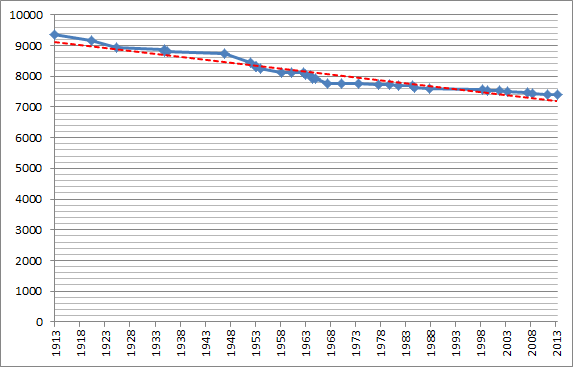

(Times on the y-axis are given in seconds)

Notably, there is a long period of little improvement from the mid-1920s to the mid-1940s, followed by the 20-period of the most rapid improvement in the last century. Why? Who knows for sure, but one hypothesis is that the worldwide depression in the early ‘30s, followed by World War II, drastically reduced both participation and opportunities to compete, two of the factors in our list.

in 1967, Derek Clayton ran 2:09:37 to take two and half minutes off the record. Clayton was a training machine, reportedly running 160 miles a week or more, and most of it hard. Not a typical track runner, his training typically consisted of 10-12 miles in the morning and another 10-12  miles in the evening. Here then, is another factor in improvement: training innovation/more rigorous training. Unfortunately for Clayton, he spent most of his career dealing with overuse injuries. Alter-G treadmills and pool running hadn’t been invented yet, making recovery more challenging.

After Clayton, progress slowed down. It took 17 years to lower the WR by a minute and a half, with Steve Jones running 2:08:05 at Chicago. Was mankind approaching the limit of marathon performance? Not quite. Only a year later Carlos Lopes improved the record by almost a minute at Rotterdam. Why did that happen. Well, Lopes run was significant for several reasons:

  1. Rotterdam was designed to be a very fast course (max elev. 49’)
  2. Lopes had multiple pace-setters, an innovation in those days
  3. Rotterdam, like other races, was beginning to offer big prize money

In other words, record-setting was becoming a higher priority/more lucrative — both for race organizers and the competitors.

Also worth noting is that Lopes’ WR would be the last one held by a European

In April 1988, Ethiopia’s Belayneh Dinsamo ran 2:06:50, and then in September, Brazil’s Ronaldo da Costa sliced another 45 seconds off, running 2:06:05 in Berlin. Da Costa is the last non-African born man to hold the WR.

In the past 25 years, the record has been improved another 2:27. Over that stretch, there has been an increase in the number of events, an increase in the prize money (including bonuses for fast times and record), and a huge increase in the number of African runners competing, including top track runners like Tergat and Gebrselassie. So many of our record-altering factors have been coming into play. And yet, with all this change, including a huge shift in the incentives to try for records, the WR has been improved by only 2:27 in 25 years. If we look only at those 25 years, and use them to project future improvements, the graph looks like this:
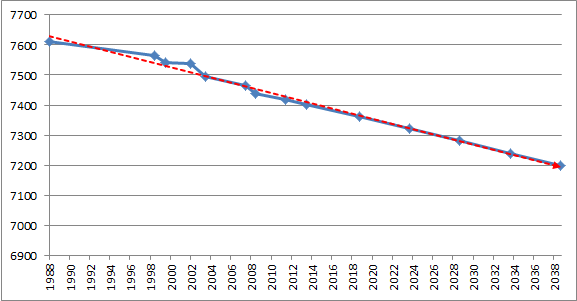

In other words, if the record keeps improving at the cureent rate (over the last 25 years), we’d expect someone to run sub-2:00 around 2038.

So the question becomes, is there any factor out there that would actually accelerate WR progress beyond the current trend? No one can say for sure, but here’s my take: I don’t think training methods will improve much. I don’t think there will be another huge expansion of the pool of participants, although there is still the possibility of bringing more potential record-setters into the sport. While I expect prize money to increase, I think that it’s already high enough so that doubling it (e.g.) will not double the incentive to train hard and run fast. I also have a feeling that watching record attempts will not become MORE popular, as the sport turns more and more toward participation for average folks.

I do think there will be technological advances, and I do think there will continue to be progress in legal ways of helping the body recover from hard training. I wouldn’t be surprised if there are advances in pre-race and in-race nutrition, hydration, and cooling. So there will be new records, but I don’t see the record dropping very quickly.

The wildcard in all of this is the possibility of illegal aids, or truly novel performance enhancement techniques like manipulating genes in the service of better endurance. There’s no way to predict if we are the verge of some discontinuous source of new records by super-runners.

Whew. I’ve spent way too much time on this. But I’m sticking with my prediction that no one runs faster than two hours in the next ten years. I’m still waiting to see whether anyone will take that bet.

POSTSCRIPT:

Robin writes to say that I should have mentioned asymptotes. Given a curve, such as the marathon WR progression over time, an asymptote is a line for which the vertical distance between the curve and the line tends toward zero as time goes to infinity. This makes intuitive sense:  there must be a limit, beyond which no improvement is possible (it’s not possible to run a marathon faster than 0 seconds!). Our intuition is that progress should slow over time, and that the improvement curve should get flatter and flatter, approaching the asymptote ever more gradually . To me, one of the most interesting things about the actual progression is that our intuition about the asymptote is so often at variance with actual performance. For example, looking at the last 100 years, and dividing that period into five 20-year periods, here’s how the record improved:

1913-1933:    5:08  (2:36:06 to 2:30:58)
1933-1953:   12:23  (2:30:58 to 2:18:35)
1953-1973:    9:06  (2:18:35 to 2:09:29)
1973-1993:    3:24  (2:09:29 to 2:06:05)
1993-2013:    2:42  (2:06:05 to 2:03:23)

The long-term trend is for improvement to slow, but a) not always! and b) past results do not guarantee future returns. It would have been easy, in 1993 to conclude that we were hovering above the asymptote and that further improvements would take much longer than past improvements. Instead, from 1993-2013, improvement was almost as rapid as in the previous 20 years. The key observation is that treating this as a math problem only is not sufficient; there needs to be some wrestling with WHY records improve, and identify factors that lead to more rapid improvements then are expected.

Posted in Records & Statistics | Leave a comment

Predicting the First Sub-2:00 Marathon (Part 1)

Ok, let’s cut to the chase: I will bet you the Boston entry fee that no human being will run a marathon on a record-eligible course in under two hours in the next ten years, that is, by December 31, 2023. Would you bet against me?

Speculating about when the first sub two-hour marathon will happen is a topic that seems to pop up every year as we approach the spring marathon season. It’s harmless fun, I suppose, but for various reasons I usually find most such speculations really annoying. Here’s a recent example, from SpikesMag.com:

http://spikes-mag.tumblr.com/post/74730787108/cracking-the-sub-two-hour-marathon

The problem I have is that it’s easy for someone to argue that a sub two-hour run is imminent, while claiming that “statistics” back them up. Then they cherry pick numbers to support their position. Throw in a few historical references to the first sub-four minute mile, and the thing practically writes itself. It’s not a matter of “if,” it’s a matter of “when.” And let’s go out on a limb and say it will be “sooner than you think.” Genius.

If I’ve learned anything from spending the last 15 years working in a department of Ph.D. mathematicians and physicists it’s that even the most sophisticated statistical techniques are worthless if you’re not asking the right questions. And even if you are asking the right questions, in attempting to answer them, you’ll come up with other questions. Making good predictions depends on keeping in mind the limitations of your data. One problem we have in predicting marathon times is sparse data. Since World War II there have been only 32 improvements to the marathon WR, or one every two years.

The current marathon WR is 2:03:23, set by Wilson Kipsang who ran that time at the Berlin Marathon 9/29/13. The previous WR was 2:03:38, set by Patrick Makau, also at Berlin on 9/25/13. In fact, the previous five WRs have been set at Berlin, going back to Paul Tergat’s 2:04:55 on 9/28/03. So the record has been lowered by 1:32 in the last ten years.

So we will know and appreciate what we are talking about when we talk about a sub-two-hour marathon, running 1:59:59 means averaging 4:33 per mile, 14:08 per 5k, and, of course, 59:59 for each half. Those are pretty scary numbers, but (so the argument goes) it always looks impossible until someone does it, and then in retrospect it looks inevitable. Thank you, Roger Bannister.

So let’s assume that it will happen, the question is when. And to answer that question, we have to grapple with the question of WHY — why is the marathon world’s best where it is right now. Why has it improved over time? What factors will lead to further improvement?

And it occurs to me that this question has more than academic interest, and significance beyond a fan’s appreciation for elite distance running. The question of what leads to improvement is one that all of us struggle with in our OWN running, however humble our times. The runner who is training for a Boston Qualifier, or to break 3:00 hours, or just to set a personal best, has to figure out why they improve. The easy answer is “more training,” but that hides a world of complexity.

In Part 2, I want to look at the last 100 years of marathoning and make some observations about the WR progression (stopping along the way to critique the previously mentioned article). More importantly, I want to try to make an inventory of possible explanations for past improvement, consider likely factors for continued improvement, see if there’s any data for those factors, and only then venture a guess at when we’ll see that first sub 2:00.

Stay tuned!

Posted in Records & Statistics | Leave a comment

Alan Webb Moves On

WEBB

On May 28, 2001, a slight, but powerfully built 18-year-old high school kid from South Lakes High School in Reston, Virginia, stood on the starting line for the mile run at the Prefontaine Classic in Eugene. Alan Webb was a phenom, having run a sub-4:00 mile indoors earlier that year. Now he was gunning to be the first high school miler in over 30 years to go sub-4:00 outdoors.

But he was just a kid. You had to feel sorry for him, standing there on the line with Hicham El Guerrouj , Kevin Sullivan, Bernard Lagat…

Looking at him, NBC’s announcers worried out loud that he would be in over his head. How would he handle a professional race, with pacers hired to take the pack through the first lap in 56-57 seconds. It seemed more than likely that Webb would either go out way too fast and blow up, or be left trailing the pack, too far in arrears and with no help to make a run at four minutes. When he settled comfortably at the back of the back through a 59-second first 400, everyone was relieved. Webb was running smart. Hopes for a sub-4:00 were alive.

Now, more than twelve years later, it’s hard to summon up the sense of astonishment at what happened in the last lap of that mile. The high school kid passed runner after professional runner, kicked it in to run 3:53.43 the fastest high school mile by any American ever… Hell, the fastest mile by ANY American in three years.

Some have written that Webb’s race shook American middle distance running out of its long slumber.  If that’s true, it was not an immediate effect. It would be several more years before Americans began showing up in the World Top Ten lists.

And Webb’s running career was frustrating to say the least. He was injured too often, switched training philosophies too many times, and squandered his opportunities in championship races. His message board detractors had a cruel field day mocking his comeback attempts. His admirers pointed to his remarkable range — 1:43.84 for 800; 3:46.91 mile; 13:10.86 for 5000; 27:34.72 for 10,000m in one of his only times running that distance.

But the numbers don’t really capture the fact that for a few years, he was the closest thing to a track rock star that we had. When he ran that 3:53 in high school, anything seemed possible. (Unfortunately, the video is no longer available for viewing online, as USA Track and Field has exercised their copyright to have YouTube and others take it down.)

Now, at 30, he’s moving on to the triathlon. His goal, he says, is to be good, to compete, to try to make the 2016 Olympics. I hope he achieves all those goals, and finds a new home in a new sport. But I am quite sure he will never do anything as exciting as that day in 2001, when he sprinted down the homestretch, closing on Lagat and El Guerrouj.


Posted in Pro Runners | 1 Comment

Echo Chamber

On Saturday night at BU, Galen Rupp made it two-for-two; the Oregon Project’s most decorated athlete added another American Record to his resume, running two miles in 8:07.41, two seconds faster than Bernard Lagat’s time from last year’s Millrose Games, and only three seconds off Kenenisa Bekele’s world record.

I had journeyed to BU for the 5K record nine days earlier. I watched the two mile, however, from the comfort of my living room (made possible by my deciding to shell out big $$ for a Flotrack Pro subscription). It wasn’t the same as being at the track, but it was a pretty good deal all the same. The coverage was informative, the splits were plentiful, and the announcers did a great job communicating the excitement in the building.

It’s no wonder that Rupp and the Oregon Project have adopted BU as a venue for record attempts. Not only is the track fast, the building is fast. Even a moderate-size crowd can make a lot of noise, and having that crowd practically on top of the track, urging you on, can make a big psychological difference in running fast times. Add to that the cooperation of the BU staff for scheduling the races, as well as the pre- and post-race workouts, and it’s an ideal set-up for a detail-minded coach like Salazar.

And we, the Boston running community, benefit by being able to rub elbows with some of America’s best distance talent. I don’t mind admitting that it was cooler than cool to arrive at the track on Thursday night to see Jordan Hasay, Mary Cain, and Treniere Moser finishing up their light day-before-the-meet session with some strides, and then see Rupp knock off a few sub-60s 400s just to stretch his legs. It’s inspiring to run on the same track — perhaps even to run faster thinking of all that speed on display.

But I can’t help wonder about the echo chamber. For me and probably for you (since you’re reading this), it’s great to watch someone go after records, but it’s also got a limited appeal to anyone outside the very hard-core running order. It’s great to stand and cheer inside BU’s lyrical bandbox of a track, but on the day that Rupp ran his 2-mile record, there were 5 times as many people watching a high school track meet at the Reggie Lewis Center a couple of miles away. One guess about which event got more coverage from the local papers.

One of the most interesting things about taking in Rupp’s record attempt from home was the experience of watching it with my non-running spouse.

“So is this a big, important race?”

“Uh, no, not really. It’s just that BU has this really fast track, and everyone comes to this meet to run fast times, and try to qualify for championship meets later in the season.”

“So why are we watching?”

“Well, Galen Rupp — he’s probably the top distance runner in the U.S. right now — he’s going for an American Record in the indoor 2 mile.”

“Is he trying to qualify for something?”

“No, actually nobody else in the world really runs the 2 mile. Usually they run 3000m.”

“Why isn’t he running 3000m then?”

“He actually already has the American record for 3000m.”

“Oh”

“And he used to have that 2 mile record, but then Bernard Lagat took it away, and now Rupp wants it back.”

“Well that wasn’t very nice of Lagat.”

“No, I guess not. Anyway, he’s got all these guys in the race to set the pace for him.”

“Isn’t that cheating?”

“No, it’s not cheating. I mean, Bannister had two pacers when he broke the four-minute mile. If he didn’t have pacers, then the race would get tactical.”

“What does that mean?”

“That means that no one wants to lead, because it’s harder to lead than to follow. So everyone runs slowly so that they won’t have to lead, and then at the end, everyone sprints like crazy, but the overall time is slow. So when someone wants to go for a record, they hire a couple of “rabbits” — runners who set the pace for a while and then drop out. So Rupp doesn’t have to worry about anyone else in this race, Basically everyone is in it to help him run fast.”

And so on. And then we watched the race, with me making occasional comments about the rabbits or the pace. It was impressive, but when it was over and Rupp had lapped everyone in the field and gotten the record, there was definitely something missing. The excitement of actually being there didn’t translate well to our living room. Nor, I suppose to the pages of the Globe and Herald.

Posted in Pro Runners | Tagged | 1 Comment

Can Runners Learn from “House?”

I was talking with Joni last week and she was giving me the latest report on her foot/ankle injury. Like many running injuries, there was no unambiguous explanation for it, only a combination of hard runs and exercises that, in retrospect, overloaded something. It was one of those injuries that only announce itself in the morning, after a good night’s sleep. “Oh, you thought you were going to run today? There’s been a change of plans.”

We’ve all been there.

Fortunately, Joni’s latest report was good. After a couple of days off with icing and ibuprofen, and despite some continued pain, Joni had started short runs again, testing it out and monitoring the results. After several days of experimenting in this way, she had been able to better isolate the pain, and had noted some patterns of when it did and didn’t hurt. That had led to more effective icing, etc., and finally, that morning, she had been able to run ~4 miles completely pain-free.

It’s interesting to me that Joni’s injury seemed to get better even though she continued running. The real question in my mind is whether it got better DESPITE her running or BECAUSE of her running. And if it was BECAUSE of her running, what did the running do, exactly? Did continuing to run hasten physical repair, or change the feedback mechanism, or what? As we pondered these questions, Joni suggested it was like an episode of the TV medical drama “House,” and the analogy got me thinking…

On the show, Hugh Laurie plays the brilliant but caustic Dr. House. Although he heaps verbal abuse on his patients and his colleagues (perhaps because he lives with a painful, permanent injury himself), he also excels at identifying the mysterious ailments that baffle the conventional medical minds around him. One of House’s favorite techniques is to bombard his patients with treatments that aren’t necessarily designed to solve the problem, but rather to force the body to show its cards, so to speak, and to reveal what’s really going on.

dr-house-quotes-on-lovedr-house-quotes-----time-changes-everything-simple-interesting-6vt6w3p4

The conventional, by which I mean conservative, approach to most injuries is to rest them until they get better. A more advanced form of the conservative approach is to throw in physical therapy to strengthen or correct the weakness that led to the problem in the first place. It’s an old joke that when a runner tells his or her doctor that something hurts when he runs, the doctor says, “well, don’t run then!”

But in my experience, almost every serious runner keeps running through a lot of minor and some major hurts. Stubbornness? Yes, but not only that. In addition to not wanting to miss the daily run, the injured runner has another compelling need, that is, to get better information about the injury: What hurts? When does it hurt? What makes it hurt? Is the hurt getting worse or better or staying the same?

Some injuries present clear and classic symptoms, making diagnosis easy. But many injuries present inconclusive symptoms, or they masquerade as something else: the “hamstring pull” that turns out to be a hip flexor issue; the “IT band inflammation” that turns out to be bursitis; the “plantar fasciitis” that turns out to be a bone chip in the heel; the calf muscle strain that turns out to be deep vein thrombosis. Oh yes, there is plenty of material here to supply several seasons of a medical melodrama.

And because few of us know real-life versions of the Hugh Laurie character, we act as our own Doctor House, trying stuff — experimenting on ourselves — to see what will happen. Can this approach work? It seems at least a little unwise, but sometimes it does work. By running a little, by exposing the body to some of the stress that got it hurt in the first place, the patient — I mean, of course, the runner — begins to figure out the injury, its extent and severity, and maybe even what to do and what not to do to coax the injured part back to health.

There are risks, surely. One of the biggest risks is that patient in us is in a state of denial (this is usually the case for Dr. House’s patients, too). It’s tough to be objective when you are the object under consideration. Or, as Richard Feynman put it, “The most important thing is not to fool yourself. Unfortunately, you are the easiest person to fool.” Why? Because you, of all people, want things to come out a particular way.

Hugh Laurie’s character understands that his patients are often part of the problem, and that’s why he tends to ignore what they say (“Everyone lies”) and instead focuses his attention on what happens to their bodies with each new treatment. I wonder whether we’re capable of reaching that state of detachment that enables us to focus on the experiment without having too much invested in the results.

I’m sure that real doctors (Robin, are you out there reading this?) cringe when people like me bring up this fictional doctor. I’m sure that real medicine doesn’t look anything like the fictionalized version in the popular show. My point is not that House represents reality, but rather that House represents a longing for insight and knowledge in a confusing world full of unexplained pathologies.

Can runners learn from House? Yes, but only if we are really committed to learning, rather than simply looking for reassurance.

Posted in Injuries & Health, Uncategorized | Leave a comment

Mid-Winter Stirrings

More snow is falling in what has already been a snowy winter. That’s good news for Terry and all the other skiers who’ll enjoy frolicking in several inches of fresh powder. For the rest of us who don’t have a passion for winter sports to keep us occupied, the instinct to hunker down is strong. But for me, at least, there is another instinct that urges me to resist hunkering.

Although New Year’s Day holds no special meaning for me, late January does. Maybe having a mid-winter birthday has forged an association of ideas, specifically that this is the time of year when plans are altered or new ones made, when new enterprises are begun, when decisions of great importance are made. Whatever the reason, I begin to feel a soul-stirring and an eagerness that stands in contrast to the bleakness of the landscape.

For me, the fourth week of January is a time of momentous changes — both good and bad — and always has been. Unlike most of my classmates, I finished high school in January and began college in January a couple of years later. I started my first (and many subsequent) jobs in January. I became a father in January, and became a grandfather in February (which is just January staying too long at the party and refusing to leave). Three years ago, my legs and lungs got clogged with clots in January, although I wasn’t paying enough attention and didn’t notice it for a couple more weeks. And now in 2014, these stark mid-winter days have me feeling like something’s going to happen, like I’m a pebble kicked from a ledge, beginning to tumble, beginning to roll down the slope, picking up momentum, picking up speed.

Out in the world, the cold continues, but the lengthening of the days at this time of year is a daily reality.

In Boston, sunset is later by more than a minute every day. By the end of the month, the sun won’t be dipping below the horizon until almost five o’clock. Office workers will leave their buildings with light in the sky. High school students will be able to finish their afternoon practices and emerge into daylight for the first time in two months.

As the snow reminds us, we are not done with winter, not by a long shot. But when the temperatures linger in the single digits, as they will in February, I will repeat this mantra:

“The light returns before the warmth.”

And I will be content, for now, with light. I’ll celebrate a birthday and for a few weeks, at least, I’ll hope to feel like a newly minted 56-year-old, rather than a tired 55-year-old. Such are the mental games we play with ourselves. It’s the fourth week of January and a time for new beginnings, with every expectation that this is going to be a good year, a year of longer long runs and harder track workouts and races and getting stronger and faster. Why not? It’s January, change is afoot, the light is on the move, and anything is possible.

Posted in My Back Pages, Weather and Seasons | 1 Comment

Race Report: 3000m at GBTC Invite

A couple of weeks ago, I watched Craig Fram and Paul Hammond absolutely hammer an indoor 3000m at the final BU mini-meet. That race is now on YouTube, and is worth watching again, if only for the desperate (and successful!) lean, and subsequent fall by Fram. But it wasn’t just the final gutsy finish that impressed; it was the way both old warriors attacked the race, and how well the distance seemed to suit their ability to grind and grind.

I  ran the 3000m during the GBTC meet at Harvard on Sunday. I dunno. It’s a tough distance. It always feels like it’s always run right on that red line. The last few times I’ve raced the distance, I’ve had no kick at all, just wobbly legs that barely keep me moving forward. Sunday was like that.

So after singing the praises of the mile in my blog last week, and running on one of the few remaining 440y tracks in existence, why race the 3k? The choice was a practical one. The 3k was early, and all the other possible races (the open mile, masters mile, even the masters 800) were later. With several Concord Academy runners coming to the meet, I wanted to get my own racing out of the way before switching into coach mode.

I got in a long warm-up outside, but still had plenty of time to do a full set of drills. Even with the warm-up and the drills, I didn’t feel great. Even though the last few days had been very light, I felt not-quite-recovered from the previous Sunday’s long run and the very sodden seven-mile slogfest on Tuesday. My body wanted to run long and slow, maybe for another 10-12 miles, rather than compress the same amount of effort into 10 minutes of hard running.

I was seeded fifth in my section, but I had no intention of doing anything other than heading right to the back of the pack to run 40-second quarters for as long as I could. Fortunately, I had Joe Fischetti and Stephen Peckiconis both yelling splits to me every lap (from different locations). 40-40-40-40-40. Oh, there were tenths of a second in there, but I don’t remember any of them. I think the first 1k was about 3:21.

I had told Joe that I wanted to negative split each 1000m, but I had also expected to feel just a LITTLE bit more comfortable after only a third of the race. Still, a plan is a plan — I tried to pick it up just a bit. I also went by a couple of guys who were slowing down. I made it to the mile at around 5:21. A couple more laps and I hit 2k in about 6:41. Everything seemed to be lined up for me to run under 10 minutes. Unfortunately all the little dials on the instrument panel were starting to swing ominously over into the red..

For each of the last five laps, Joe screamed out a split with a few more tenths of a second added on. I wasn’t dying, exactly, but each of those laps was eating into any reserve that I might have been able to throw into the final sprint. But that’s always been my experience of the 3k

The last couple of laps I knew that I wasn’t going to break 10:00, and I just wanted not to give too much away. On the last lap, I tried to shift my cadence, tried to generate some force, tried to kick like I had imagined kicking, but I succeeded only in maintaining the pace. I crossed the line in 10:03.25. I immediately went hands to knees, feeling relief but no elation. Mostly, I was mentally fatigued from pushing and not being able to go any faster.

From one perspective, it was a pretty solid race. I ran roughly 40 seconds for each of the 15 laps and finished completely spent. So it was well-paced, at least. From another perspective, though, it felt like the race lacked something — maybe a change of pace. Or maybe, I just haven’t figured out how to run 3ks yet. Honestly, I think about Fram and Hammond and I wonder how they do it.  

Posted in Indoor Track, Racing | 1 Comment