Watching Them Play

At Concord Academy (where I coach), the academic calendar mandates that spring sports start in February with two weeks of preseason, followed by two weeks off for school break, followed a restart at the end of March. I’ve just survived those first two weeks, and I’m still recovering.

Not only is it strange to practice for two weeks, take two weeks off, and then start up again, it’s a huge challenge to figure out how to practice when it’s 20 degrees outside and all the fields are covered with snow. I mean, it’s fine for distance runners who are used to running in real weather and have, by now, figured out how to dress for it. But it’s tough for everyone else.

Practicing indoors is possible, but problematic. CA is not a large school and does not have anything like a field house, let alone an indoor track. The full range of indoor athletic facilities includes:

  • a gym with side-by-side basketball courts

  • a wrestling room

  • four squash courts

  • a fitness center with a few cardio machines and lots of weights


Into these cramped quarters, the school squeezes a baseball team, a softball team, two lacrosse teams, two tennis teams, an ultimate frisbee team, and — largest of all — the track team.

Every afternoon during preseason, the SHAC (Student Health and Athletic Center) becomes a hive of attenuated athletic activity, with everyone trying to figure out how to practice in the limited space. It’s not unusual to have all of the available facilities occupied, plus the main atrium, the corridors outside the gym, and of course the two flights of stairs, as teams with no assigned space try to get in a workout.

With all that as context, I’m feeling pretty good about how these two weeks went. We ran, we lifted, we did core, we did drills, and we even managed to throw (don’t ask). Best of all, no one got hurt and we didn’t break anything important.


As I take stock of what worked and what didn’t work, what I want to change, and what I have to do to prepare for the restart at the end of March, I also can’t help but ponder the question that underlies the whole season, and seasons past and future. Why do I do this? After all, I’m an introvert; being around people for extended period is exhausting for me. How is it that I return again and again to this job where I’m surrounded by young people, where I need to be “on” for hours on end, where I give up “me time” and solo afternoon runs?

It’s a complicated question, and I won’t try to give a complete answer. But recently, I gained a bit of insight from an article by Brad Griffin of the Fuller Youth Institute entitled “The Only Six Words Parents Need to Say to Their Kids About Sports—Or Any Performance.”

As the title suggests, the article contains advice — good advice, I think — for parents or anyone else who wants to see kids both enjoy sports and also experience the satisfaction of being successful. It’s worth thinking about how to encourage without intentionally or unintentionally adding unneeded pressure. I liked what the article had to say, but that’s not the only reason that I responded favorably to it.

The six words are “I love to watch you play.”

(For the record, it’s the right thing to say only if it’s true.)

The revelation for me was that those six words, slightly modified to take into account that what I do is definitely not the same thing as parenting, describe pretty well how I feel when I’m coaching. I don’t know why it’s true, but I really do love to watch athletes — especially teenagers just beginning to think of themselves as athletes — run, jump, and throw. I love to be witness to the process of discovery that takes place with training and competition. To me, the effort is beautiful; the amount of learning that happens is inspiring.

If I’ve gotten better as a coach, and I hope I have, it’s only because watching athletes become vulnerable in the way that track and field makes one vulnerable has motivated me to step outside my own comfort zone. I didn’t know anything about the triple jump until I worked with an athlete who wanted to do it and do it well. Likewise for the shot put, javelin, 100 hurdles, and — God help me (and the kids) — the pole vault. I would never have learned about these events except at some point some kid tried each one and found a home in it.

Im really grateful for two weeks without the daily chaos of track practice and all those energetic kids, and I know that break will help me recharge.

Nevertheless, a part of me can’t wait for the last week of March and another chance to watch them play.

Posted in Coaching, High School Runners | Leave a comment

Bekoji

The March issue of The Atlantic has an article about the town of Bekoji (Little Town of Champions), a farming village of ~17,000 located in the highlands of Central Ethiopia that is remarkable for producing world-class distance runners. Incredibly, runners from Bekoji have collectively won 16 Olympic medals over the last 20 years.

Bekoji’s world-class daughters and sons include Derartu Tulu, Fatuma Roba, Tiki Gelana, Mestawet Tufa, the brothers Kenenisa and Tariku Bekele, and the sisters Ejegayehu, Tirunesh, and Genzebe Dibaba.

The article considers many factors that might explain how a small, obscure village could produce more Olympic medals in distance running than the country of India (pop. 1.2 billion) has won in all Olympic sports. Ultimately, the article doesn’t find any reason that Bekoji is unique, and arrives more-or-less by default at the conclusion that it must have something to do with the local coach, Sentayehu Eshetu, who trained most of Bekoji’s most successful runners.

Strange that the article doesn’t mention the full-length movie (Town of Runners, 2011), which tells a richer, more nuanced story about Bekoji and the struggle of two teenage girls from the town, as they attempt to follow in the footsteps of the Dibabas. The movie is not pessimistic, but it does a much better job than the Atlantic article of documenting the almost insurmountable obstacles standing in the way of the young athletes. (Spoiler alert: neither girl makes it to the 2012 Olympics.)

One of my favorite scenes from the movie is when all the runners show up at the local dirt track with shovels and rakes to remove the grass and weeds that have taken over during the rainy season, spreading across half the lanes. In the movie, Coach Sentayehu bemoans the fact that a single bulldozer could do the work in an hour that takes his entire team a full day.

Somehow, that image acts as an antidote to the thinking that being born at 2800 meters in a town that no one has ever heard of is all it takes to guarantee an Olympic medal.

Posted in Uncategorized | 2 Comments

It Takes a Village (to set a WR)

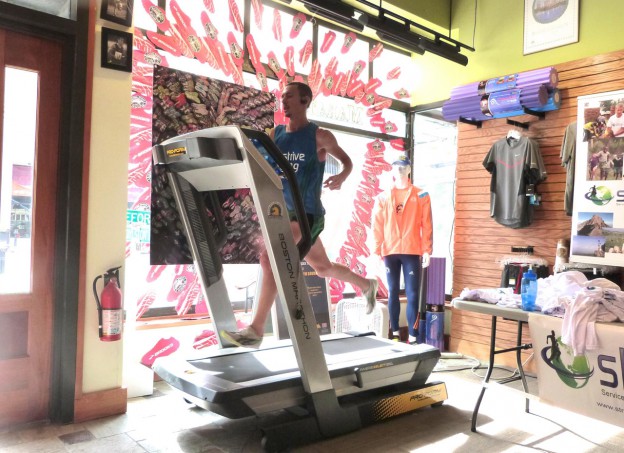
0303_tyler-treadmill-624x453

On Saturday morning I watched Tyler set a world record for the fastest half marathon ever run a treadmill. He accomplished the feat running on a machine set up in the front of the Marathon Sports store near the Boston Marathon finish line in front of a crowd that included friends, family, members of the media, and a few people who arrived at the store expecting to buy shoes and ended up staying for the drama.

(You can watch a replay of Tyler’s run here. You can also hear an account of the event that was broadcast on National Public Radio’s Here & Now.)

The idea of staging this very public WR attempt had followed a fundraising event in the fall that also involved treadmill running. For that previous event, Tyler had challenged himself to run as many consecutive 5-minute miles as possible on a treadmill and had asked people to pledge a certain amount for each mile. The funds would support the charitable work done by Strive Trips, Inc., the organization that he co-owns with two friends. On that day last November, he set the treadmill at 5:00 pace and didn’t stop until he had covered 13.2 miles, passing the half marathon in 1:05:30. It was only later that he found out that, had it been done in a certified WR attempt, his time would have beaten the listed world record of Olympic steeplechaser Andrew Lemoncello by two minutes.

With the help of Karyn Miller-Medzon, parent of a Strive student, and producer for NPR’s Here & Now, Tyler planned an encore for the spring, but this time doing it according to all the guidelines required for record consideration.

I hadn’t planned to take much of an active role in the attempt; I was just there to support Tyler and cheer him on if he needed cheering. Instead, I ended up becoming the emcee and a part of the spectacle. Tyler had written down the splits he would need to break the record, and, since I never travel anywhere without a stopwatch, I volunteered to take his actual splits and announce them to the crowd. After I had done this for the first 2-3 miles, I realized that these periodic updates were the only way that the crowd knew what was going on. Although Tyler was able to see the treadmill console, and so knew his pace and his splits, everyone else just saw him running in place, becoming progressively more tired and sweaty.

The first couple of miles, my announcements were pretty vanilla, but as the minutes went by, like everyone else I started getting caught up in the building tension.

“Tyler’s last mile was 5:05, and he is now 10 seconds UNDER world record pace!”

“Tyler has just reached the halfway mark in 33 minutes and 30 seconds. That is 14 seconds UNDER the world record pace!!”

Tyler was slowly building up a cushion, but as his feet continued to slap the belt of the relentless machine as it sped underneath him, I thought his face was beginning to express something more than concentration, something that looked like the beginnings of fatigue-despair. After he had reached 7 miles, I walked around to the front of the machine, holding up a piece of paper with his last several splits. He looked at them for a split second and then closed his eyes.

There was a long way to go.

In between checking mile times, I had lots of time to walk over to talk to Tyler’s parents, as well as check in with Karyn, who was recording the event, and say hello to a few other people I recognized.

Tyler ran his 8th mile in 5:05, and then a few moments later, there was an audible change to the sound of the treadmill motor. Several of us looked at each other and wondered what had just happened. What had happened was that Tyler had punched in a new, slower tempo. After six straight miles of hearing the same note, the Doppler shift to a lower pitch sounded ominous.

Tyler ran his 9th mile in 5:22, putting him a mere 5s ahead of the WR split. A moment later, he increased the speed again. Mile 10 was 5:08. Sensing that this was getting serious, the crowd began to offer shouts of encouragement without being prompted. I can only imagine what Tyler’s parents were feeling at this point.

When Tyler punched the controls to slow the pace again, we knew what it was right away. The 11th mile passed in 5:18. For the first time, Tyler was a few seconds behind WR pace with two miles to go. Reaching deeper, Tyler increased the pace. He ran the 12th mile in 5:11, meaning he would need to run 5:37 or better for the final 1.1 miles to get the record.

Later, Tyler would say that in addition to being really tired, his calves were killing him, perhaps the result of trying to generate speed on the soft surface of the treadmill, or perhaps because he hadn’t done sufficient training at 5:06 pace. Nevertheless, he threw himself into the final mile with a vengeance. He hit 13 miles in 1:06:50, a 4:58 split, and reached 13.1 in 1:07:19 before stepping off the treadmill and collapsing on the floor. He had broken the record by 10 seconds.


Under almost any circumstances, a treadmill record attempt is a strange sub-genre of distance running. Heading into Boston to watch, I didn’t really know what to expect. In the end, what impressed me most was what a collective effort it was.

Of course, Tyler did all the actual running, but the record is, by definition, public “property” (the venue must be open to the public at all times). On a deeper level, Tyler wouldn’t have been there at all if it weren’t for Strive, and who knows whether he would have found the determination to push on without the motivation and encouragement of the crowd around him.

Posted in Records & Statistics | 3 Comments

Hope Springs Eternal

adidas-springblade-razor-blue-silver-1

My wife is not a sports fan.

In fact, I sometimes think that her favorite “sport” is baiting me, which she does by calling my attention to articles in mainstream (i.e., non-running) publications that she knows will set me off on an indignant tirade.

As a recent example, I came home one day last week and saw that she had left the Business section of that day’s Boston Globe on the kitchen table. The lead article, which took up two-thirds of the front page and continued inside, was titled “Shoe Technology Races Ahead” (get it?). It was a breezy view of trends and new products in the running shoe biz, and it contained gems such as:

“The running industry wants to put a spring in your step — literally.”

Naturally, I had to read the whole article, and it wasn’t long before I was audibly sputtering, and Ann was barely hiding her considerable amusement. 

Accompanying the story were brightly colored photos of three new shoe models, the Adidas Springblade Razor (an update to the original Springblade model), the Nike Flyknit Lunar2, and the New Balance Fresh Foam 980. The text quoted a footwear buyer from CitySports (I know that’s where I would go for running shoe advice), a senior product manager for New Balance, and a design director for Advanced Concepts from Adidas.  

Just thinking about the Adidas shoe makes me unhappy.

I had a friend in college, a physicist and all-around brilliant guy, who used to dismiss really bad ideas by saying, “It’s not just wrong, it’s wrong-HEADED.” I always took that to mean that a clever solution can be worthless if it’s not solving the right problem.

The Springblade attacks the problem of storing and releasing energy from ground impact forces by outfitting a shoe with over a dozen mini polymer blades that act as springs. From what I can tell, the really innovative part about the Springblade is that each blade is set at a different angle, to change the vector of the reactive force, or, to use the marketing parlance, “To propel the runner forward.”

Of course, sneaker companies have been making similar claims for at least eighty years, and probably longer. Does anyone else remember the PF Flyer? According to Wikipedia, they were first manufactured in 1933 by BF Goodrich. In the sixties, when I was a ten-year-old boy, the PF Flyer with its “magic wedge” seemed like the coolest shoe in the world, and I completely accepted the proposition that I would run faster and jump higher with those babies on my feet.

220px-Pf_mid

Ah, youth.

I’m all for storing and releasing energy. In fact, a very significant portion of my life has been dedicated to strengthening the tough elastic tissues in my body to do exactly that. I have spent years learning to use those tissues more efficiently. The idea that a shoe with blades will give me the same results and skip past all of that bothersome training stuff is more than mildly offensive. 

But I might be wrong. I’m no structural engineer. Maybe polymer springs on shoes WILL turn out to be the great footwear innovation that enables all of us to get faster for free (well, for $180 retail, but you know what I mean). And maybe there’s something in cold fusion after all. But my instinct is that messing with the essential physics of running is going to be problematic for most runners, leading to different movement patterns. If the shoe really did offer an advantage over conventional shoes, I would expect that a runner would need to train specifically to take advantage of that advantage. Lunches are never free. 

The other shoes mentioned in the article were headed in a different direction. Both the New Balance and Nike shoes seem to be part of a trend that combines some minimalist ideas with better cushioning and a custom fit. Apparently, today’s shoe buyers love the idea of lightweight, low-profile shoes, but still want to reduce the sensation of repeated blows against the unyielding pavement.

I don’t mean to sound cynical. I know how important it is to feel good in your shoes, and to have confidence that they are doing their best to protect you from all that pounding. I buy a lot of shoes, so who am I to complain if shoe companies continue to look for ways to make me and the rest of the shoe-buying public happy? But I get tired of the gimmicks and I get tired of the outlandish claims that shoes alone will soften the hard truth of high-mileage training.

In the end, I think most people will purchase shoes based on what has worked for them before and on what colors make them feel better on a cold February day when the world is a hard and harsh place.

Posted in Uncategorized | Leave a comment

What a Coach Wants

“My intention was what every coach wants—to advocate for my athlete. It was a physical race and when I saw the contact and the flag go up, I filed a protest.” – Alberto Salazar

When the Wall Street Journal spends 744 words covering a disqualification in a track meet (USA Track Reinstates Disqualified Champ Grunewald), there is obviously more at stake than whether a particular athlete broke a particular rule.

If you haven’t been following it, the case involves the final lap and ultimate results of the women’s 3000m at the US Indoor Championships last Saturday. With less than 200 meters to run, Gabe Grunewald, who was in third at the time, clipped the back foot of Jordan Hasay, who was in second, causing Hasay to break stride. Grunewald, who was accelerating, went by on the outside and went on to win the race, her first U.S. Championship, while Hasay faded to fourth. The contact between the two runners was flagged for review, but the initial review found no grounds for disqualification. Alberto Salazar, Hasay’s coach, filed a protest. It was denied. He appealed the decision, and the jury of appeals reviewed video of the race and then denied the appeal. What happened next is why the running community is all a-Twitter with accusations and counter-accusations, why the WSJ is spending time on the story, and why there still might be repercussions to USATF, the governing body for Track and Field in the U.S.

Briefly the question is whether, after the “final” ruling of no foul, USATF was influenced by corporate interests (Nike) to go outside its own rules and reverse the decision of a referee and Jury of Appeals in disqualifying Grunewald. That decision sparked protests and an explosion on social media. It was an ugly situation for the athletes involved, especially Hasay, who seemed the innocent victim of both the original contact and the subsequent actions taken by her coach and others on her behalf to protest the results. After a fraught 48 hours, Monday night brought more drama as Hasay released a statement withdrawing her protest, and USATF released a statement in which they reinstated Grunewald as the winner. But the story has not been put to rest. LetsRun.com, among others, is now demanding an investigation to determine whether Nike coaches or employees unfairly influence the appeals process.

But I don’t want to talk about any of that.

I want to talk about Salazar’s behavior after the race, and the questions it raises about the role of a coach.

There’s no question in my mind that Salazar’s reputation has been severely damaged by this incident, and that he is the biggest loser from how events have unfolded. Although Hasay must have had a hell of a last few days, her decision to withdraw has earned almost universal respect. Likewise for Grunewald, who became for a few days a populist folk hero (#FreeGabe) but has now been allowed to go back to being a simple national champion.

But Salazar has become the symbol of toxic coaching within the long-distance running community. The message boards are sagging under the weight of anti-Salazar sentiment, personal attacks, and unsubstantiated accusations. Some of this is unfair — the Internet being the Internet — but there is something right there in the open that needs to be considered: the coach’s extreme identification with the cause on an individual athlete to the point of bending, if not breaking the rules, and being blinded to the real harm done to the athlete for the sake of winning.

Although it was meant to be anodyne,  Salazar’s statement (above) sent a chill down my spine. The words sound so reasonable; surely, every coach wants to advocate for his or her athletes, to speak for them, to argue their case. Salazar was just doing what any coach would do.

Well, no. Not every coach would interpret the events in the 3000m as confirmation that there was a conspiracy against his athletes. Not every coach would take the results of that race so personally, that he would attempt to circumvent the rules in place for everyone else to have the results overturned. And finally, not every coach would be so caught up in righting what he perceived in the moment as a gross injustice to his athlete that he would fail to realize how his attempts to do so would put that athlete in an impossible situation. The coach rages and the athlete suffers.

I don’t think Salazar is a monster, as some have portrayed him, but I believe that, like many highly successful people, he has a monster inside him. All the good things that he has accomplished as a runner and as a coach, and all the bad things he has done to undermine those accomplishments, seem to spring from an immense insecurity and a view of the world that’s based on extreme us-vs.-them. Salazar appears to treat his favored athletes like family, and will do anything in his power to promote and protect them. That’s admirable, to a point.

But the dark side is that athletes do not always need protection; sometimes they need adult advice and the opportunity to figure out how to handle adversity on their own.

While I’m no Olympic coach, and I can’t possibly fathom the pressures of a person in Salazar’s position, I can say that I’ve been involved in dozens of incidents over the years in which athletes were or might have been disqualified, and I’ve been on both sides of these situations. I’ve had athletes disqualified for uniform and jewelry infractions, excessive celebration, cutting in too early, impeding other runners, etc. I’ve watched my athletes commit infractions that probably should have been flagged, but weren’t. I’ve filed protests on behalf of my athletes for such infractions and been denied. I have disqualified my own athletes (for running the wrong way on a cross country course), when other coaches told me not to worry about it. I’ve also been tempted to break the rules myself, to ignore some silly requirement or tell a white lie, for example, entering an athlete in a JV cross country race under the wrong name.

As a coach, you’re constantly struggling to find the balance between “advocating” for your athletes and maintaining your own integrity and the integrity of the sport. At the end of the day, I think what guides you is that your actions ought to be in the best interests of your athletes, not in the narrow sense of securing a victory in a race, but in the broader sense or preparing them to live in the world with their heads held high.

Caught up in the intense emotion of that race and its disappointing, perhaps unfair, outcome, Salazar crossed a line, and became an advocate in the narrow sense and his athlete’s worst enemy in the broader sense.

Posted in Coaching, Pro Runners | Tagged , , | Leave a comment

Race Report: 2014 USATF-NE Indoor T&F Championships

I woke up Sunday morning in a surprisingly cheerful mood.

What was this all about? After all my complaining about February, what would account for this change of heart? Was it the sudden invasion of warm weather, the smell of waffles and coffee wafting up from downstairs, the sight of patches of earth in our front yard when I went out to get the paper?

Yes, it was probably some combination of all of those, plus one other thing: I was NOT heading out to Amherst to race the D.H. Jones 10-Miler against hundreds of the toughest runners in New England. Three of the last four years I have made the trek to my hometown to run in this race, which for some inexplicable reason has become a staple of the USATF-NE Grand Prix Championship Series. I mean, I love the town of Amherst, and I always enjoy seeing my Mom, who still lives there, but the race itself  is brutal, featuring nasty hills, two miles of dirt road (which is either muddy or icy depending on the weather), and the usual fierce New England competition.

But while my teammates were toiling away earning valuable Grand Prix Series points out there in Western Mass., I had other plans. Specifically, I was planning to enjoy a leisurely morning before heading over to Harvard to compete in the USATF-NE Indoor Track Championships. This was the latest step in my “master” plan to prepare myself for the USATF Masters Indoor Championships in March. Sunday’s mission was to run two hard races within the span of two hours: first a Mile against open runners, and then an 800m against a field of only masters (over-40) athletes. 

Pre-Race

My legs had been feeling pretty good considering that I’d put in some hard work the over the previous 8 days. I had raced a mile on the 2/15, run an 11-miler with Kevin and Tom the next day, snuck into Harvard to do some legitimately fast speed work with Patrick on Tuesday, and then done a few very quick 200s on Thursday. It was starting to feel normal running faster than my mile pace, a good sign that something positive was happening down there in the muscles.

I got to the track with plenty of time to do a nice slow warm-up, which included twenty minutes of easy running outside, and about the same amount of time inside doing a full complement of dynamic drills on the infield of the track. I was in the slowest of five heats, so there was no rush taking care of all the stupid little things that you have to do to have the privilege of stepping to the starting line:

  • Get your competitor’s number and pin it on
  • Check in with the clerks to let them know you’re there
  • Check in again a few minutes later to get your lane assignment and corresponding “hip numbers” to stick on your singlet and shorts.
  • Remember that you left your spikes in your bag, so go retrieve them
  • Do strides along the backstretch while trying to avoid interfering with the race that’s taking place
  • Finally report to the starter

I also had lots of time to review my race plan. I was determined to go out slowly, in last place if I could manage it, and try to run negative splits. Supposedly, everyone in the mile had run a qualifying time of 5:00 or better, but I think some of those times must have been “aspirational.” I suspected that my heat would be full of runners who would start off quickly and then die. I didn’t care; I was planning to ignore them, if I could.

The Mile

There were 17 runners in my heat, a little bit too crowded for a mile race on a 220-yard track, but not unusual for the “slow” sections. In line with my plan to run in last, I gave up my place on the starting line and chose to begin behind the runner in lane 1. When the gun went off, I waited a split second to avoid stepping on anyone’s heels, and then loped off after the field. It felt very comfortable to be in the back.

In each of my previous races this winter, I’d reached halfway feeling mentally and physically red-lined, wondering if I’d even be able to finish. On Sunday, I wanted to change the pattern: get to halfway feeling good and run negative splits if I could. The first two laps went according to plan as I ran them in 37 and 37.5 seconds, to come through the quarter at 74.5. I felt very comfortable and that it would be no problem to maintain this pace for a while. The next two laps went by very quickly, and I hit the half-mile at 2:30. By then, I had started passing other runners, but without making any special effort. I felt as though my mind was in some weird neutral state, where it wasn’t really absorbing or paying attention to the signals of impending oxygen debt that surely must be arriving somewhere in my brain. I had this strange sense of… play… and was actually looking forward to the next few laps.

As I reached the end of the fifth lap, my meditative state was interrupted by the arrival of a tactical problem. As I had foreseen, a number of runners had started too quickly, and now a crowd of them appeared in front on me, slowing down together, clogging up the inside two lanes of the track. It only took me a moment to recognize that I had to make a choice: keep to my plan of staying relaxed and kicking late, or spend the energy a little sooner than I had planned to make my way around the crowd. I chose to move, and accelerated around and past the crowd on the back straight of the sixth lap. Having kicked myself out of my steady rhythm and upped the pace, there was nothing to be done but try to hold it, so I kept pushing, hitting the three-quarter mile in just under 3:45.

My seventh lap was good, and it would have made a great final lap. Oh well. With a lap to go, the clock read 4:21, but I didn’t have another gear. I held it together pretty well down the back straight, tried to use my arms around the final turn, and got a little ugly at the end, but still crossed the line in 4:59.15, finishing 8th in my heat.

The 800m

In my experience, the physiology and psychology of doubling are very peculiar and counter-intuitive. Although the body is tired, the muscles are also awash in the various enzymes to facilitate more running. And although the mind is tired, the terror that preceded the first race has completely evaporated, and has been replaced by a feeling of detachment, a relief after the earlier anxious anticipation.  

I just finished a mile and now I’m going to race my first 800 in five years? Yeah. Whatever. No problem.

I had about two hours, so I changed out of my spikes and into my flats, and headed out for a cool down run. When I got back, I did a little light stretching. I drank some Gatorade to get my blood sugar back up (and also to fool my brain into thinking everything was fine). I elevated my legs. I hung out. 

After an hour that felt like ten minutes, I realized it was time to start getting ready for the second race. I began warming up again, performing an abbreviated version of my morning routine. I did a few drills. I switched back into spikes. I did a few strides. Through all of this, I felt very, very calm. I had no worries at all. Who worries about an 800, anyway? Maybe if you’re really fast, you worry about tactics or something, but for me the race ahead seemed very simple and straightforward: run fast enough so that it would be over before I realized what was happening.

Because this was a masters race, there were a wide range of abilities thrown together into one heat. I was seeded third, so I was right there on the line this time, and when the gun went off, I got a good start, taking over second place. (Distance runners really should practice their starts more often.)

There was one guy in the race, some “young” master, who took it out very hard. He was already a couple of second ahead as we hit the far turn. I ignored him for the moment and concentrated on running fast while exerting minimum effort. I hit 200m in about 34 and felt fine. That is, I didn’t feel like stopping. Actually, I don’t even remember how I felt; there’s not enough time in an 800 to analyze these things.

Out front, our leader lengthened his lead. He was no concern of mine. If he could run that fast, it was none of my business. And if he had erred by running his first 400 in 64, well maybe I’d have a chance to reel him in, but there was nothing to do about it for the moment, so I just kept the rhythm, hitting 400 in 68-high. It occurred to me that I hadn’t run that fast for a 400m interval all winter.

Into the third lap, and I could sense that I was slowing a little, but I was also doing a good job staying relaxed and keeping my form together. I also realized that the leader was no longer pulling away, and might, in fact, be coming back a little. Into the final lap, I finally started feeling the effects of the fast pace. I held on down the backstretch, gaining, but not by enough, and I knew I wouldn’t be able to close the gap.  With everything starting to lock up, I managed to keep my stride more or less intact across the line, finishing in 2:19.23, just a couple of seconds behind the winner.

Final Thoughts

I don’t know why I spend so much time thinking about these races, except that I learn something new every time.  Or maybe I forget and re-learn the same things over and over. I don’t know.

I think that the mile was about learning how important it is to be able to accelerate in the latter stages of the race. I need to keep working on that, by being more relaxed early. I think that the 800 was about learning that speed comes more easily when the mind isn’t anxious. I’ve been working on that forever.

Posted in Indoor Track, Racing | Leave a comment

The Five Stages of February

Denial

  • Spring is just around the corner.
  • February was snowy last year, so it won’t be snowy this year.
  • There is no scientific evidence that a rodent can predict the duration of the seasons.

Anger

  • Oh, you went to Florida for a week? How nice. May you be soaked back to your childhood by the salty, cresting slush of a thousand snow plows.

Bargaining

  • A core workout in the family room is almost like running, right?
  • Maybe if I bribe my neighbor with cookies, he will let me use his snow blower.

Depression

  • It has always been winter.
  • It will always be winter.
  • It will always be winter and there will be nothing on TV but curling and ice dancing.

Acceptance Sarcasm

  • Is it snowing again? I hadn’t noticed.
Posted in Attempts at Humor, Weather and Seasons | 2 Comments

Why Kevin Will Not Like the Movie Adaptation of “Unbroken”

Unbroken MovieLaura Hillenbrand is a terrific storyteller. I loved “Seabiscuit,” and thought it remarkable how Hillenbrand was  able to create a compelling and moving portrait of a superb, but complicated competitor who, because he was a horse, couldn’t speak for himself. When I recommend the book, I always make sure to emphasize that it’s a great book because Seabiscuit remains the protagonist.

I also enjoyed “Unbroken,” Hillenbrand’s narrative that centers around the early life and World War II experience of Louis Zamperini. Before reading “Unbroken,” I had never heard of Zamperini,  a mischief-prone teenager during the Great Depression whose older brother steers him into track and field to try to keep him out of trouble. Louis discovers a transcendent talent for running, sets an interscholastic record for the mile, and a year out of high school, qualifies for the U.S. Olympic team that travels to Berlin in 1936. In the next few years, he seems to be on the verge of becoming one of the top milers in the world, but all that changes with the arrival of global war. Zamperini enlists and rises to the rank of second lieutenant in the U.S. Air Force. While flying a rescue mission, his plane experiences mechanical difficulties and he and his crew crash into the Pacific. Only three of the men survive the crash, and only two survive the ensuing 47 days at sea in a life raft with little food or water.

And that’s just the beginning of their story, a nightmare struggle to survive imprisonment and torture in the Japanese POW camps.

Now, Unbroken is being made into a movie, directed by Angelina Jolie (trailer here). On seeing this, naturally my first question was, “What will Kevin think of it?” I remember when the book came out that Kevin gave it lukewarm reviews. If I remember his verdict was that it had “too much war stuff, not enough running.” Unfortunately, I think there are three reasons he’s going to like the movie even less.

Reason #1 – Hillenbrand’s storytelling is not cinematic

I loved “Seabiscuit” the book, but I hated “Seabiscuit” the movie. The filmmakers never did figure out how to tell a story that developed gradually over more than twenty years. But that’s the way Hillenbrand writes; her narratives are slow-moving affairs that build gradually and that, in some fundamental sense, are about persevering over the long haul.  The sheer improbability of any kind of triumph at the end, and the weight of long years of failures and misfortune, is what makes the eventual “happy endings” so compelling. Along the way, she takes her time, lingering over small things so that eventually you come to know the characters — their virtues and vices, their desires and disappoints — and feel a surprising intimacy with them. It’s hard to fit that kind of storytelling into a two-hour movie, or a three-hour movie for that matter.

Reason #2 – Running as a metaphor

If “Unbroken” were fiction, most editors would tell the author that having the hero be a world-class runner was an incongruous touch and a major distraction from the main story. So what are we to make of the fact that Louis Zamperini really was a world-class middle distance runner? Well, if you’re a runner, you might feel more keenly the loss, the waste of that prodigious talent, as so much talent was lost to the ravages of the war. If you’re NOT a runner, you might be more tempted to see Zamperini’s running talent as a metaphor for his struggle and survival. I’m fairly certain that’s what’s going to happen in the movie. It’s not a bad thing, exactly, but it’s almost impossible to avoid cliché.

Reason #3 – The Running Itself

How to say this without sounding arrogant? Even the best actors have a hard time portraying good runners on screen. No matter how skillfully directors stage distance races, they always end up looking like play-acting. I’ve written before about the scene in “Without Limits” where Lasse Viren wins the Olympic 5000m and Steve Prefontaine fades to fourth. The film uses live footage of the actual race, and intercuts it with a re-enactment, in which real-life Olympian Pat Porter plays Viren. Every time I see Porter/Viren he just looks like he’s so much better than everyone else on the track that I root for him instead of Billy Crudup as Prefontaine.

Well, I hope I’m wrong about all of this. I hope the movie is great, I really do. But somehow, I imagine that a few months from now, Kevin and I will be running on Battle Road, dissecting the movie after it comes out, and we’ll be shaking our heads. “Too much war, not enough running.”

Posted in Uncategorized | 1 Comment

Foraging

aframeDeerFor the past week or so, I’ve had an odd image in my mind, a kind of half-memory, of seeing a small herd of deer come out of the woods and wander into the backyard of our house in Amherst where I grew up. This memory has no date on it, so I don’t know if it was a long time ago when I was a little kid, or not so long ago when I was visiting my parents as an adult. But in the memory, it’s late winter or early spring, and someone — my Dad? — observes that it has been a long winter and the hungry, emaciated deer are leaving the safety and anonymity of the woods and coming into people’s backyards looking for food.

Here in the present, it’s late winter in New England, and we’re once again between snowstorms. No sooner have we shoveled out the walks and the driveway after one bout of winter weather, then  we are told another one is on the way. No single storm sticks out as being particularly epic, no “Blizzard of ’78,” but the overall effect of repeated blasts is, as Kevin says, “aggravating.”

For runners who are committed, for one reason or another, to getting in a lot of miles, the aggravation of winter induces a kind of mental numbness, distinct from the numbness of fingers and toes, but no less real. Many weeks ago there might have been something mildly heroic about braving the elements to get in that long run. Now, there’s a kind of deer-in-the-backyard quality as we search for routes that give us a chance to get in miles without running through too many snowbanks, or over too much ice, or into too much oncoming traffic.

After last week’s snow that hammered the East Coast, including Washington D.C., Joni told me about how Dennis, here fiancé (and a native of country where it never snows), had expressed incredulity that she would run in spite of a declared snow emergency in the city. Eventually Dennis will learn this is normal behavior.  I remember there was a time when my loved ones, too, expressed incredulity and — did I imagine it? — a certain reluctant admiration for my resolve, but that era passed long ago. Now, Ann expresses no surprise at what she has come to accept as a typical, albeit mildly dysfunctional habit. The best I can hope for is that she takes enough notice to scold me for not wearing a reflective vest.

The mental numbness of runners is late February is evident, too, in the decision about what constitutes a reasonable running route. Of course, for some runners, a treadmill or an indoor track solves the problem. Kevin told me yesterday that a fellow age-group competitor of our acquaintance was doing his long runs in the Lexington Field House (9 laps to the mile). If that sounds tedious, it’s not so very different from the routes chosen by those of us committed to running outdoors. Last week, a day after a foot of snow had fallen on Greater Boston, I completed a 45-minute run in Burlington that consisted entirely of loops through the parking lots of nearby office buildings. Yesterday, Tom admitted he had just recently done a three-hour run in which he had never strayed more than three miles from his house. At least there have been no parking garage runs for me this winter, at least not yet.

All this brings me back to my image of that small herd of deer. During yesterday’s run through Arlington and Winchester, I kept thinking about those scrawny deer foraging for food in suburban backyards, just as we scrawny runners were now foraging for relatively bare pavement down streets that we would normally avoid, drawn away from our usual secretive trails to show ourselves on public thoroughfares, searching, searching, searching for good footing.

Posted in Weather and Seasons | 1 Comment

e(Go): Measuring Relative Esteem of Olympic Gold Medals

I don’t know about you, but I find it hard to watch certain events at the Winter Olympics without wondering about the relative importance of some of the more marginal sports. Well into my second hour of watching curling, I started thinking to myself that even if their physical weights are the same, not all gold medals are equally impressive.

I mean no disrespect. I’m sure that curling is difficult and stressful. And I’m aware that sliding down the mountain in a 4-man bobsled is dangerous. I’m also convinced that the third-line defenseman for the winning hockey team has played a valuable role in the team’s success and deserves to stand on the podium and have that glittering disc hung around his or her neck. It just seems to me that it’s much, much harder to win a gold medal in, say, individual giant slalom.

And if you want to compare the Winter Games to the Summer Games, isn’t it a heck of a lot more difficult to win the 5000m run than to win the 5000m speed skating title?

Imagine you are at a party, and someone points out a person across the room and says, “you see so-and-so over there? You wouldn’t believe it but twenty years ago, s/he won an Olympic gold medal!” Keeping in mind the relative likelihood of such a thing, what is your first guess about their sport? And how does the sport influence how impressed you are?

As I thought about this, it occurred to me that we should have a rigorous way of comparing the relative impressiveness of gold medals in certain sports. I don’t mean the commercial value (how much someone benefits financially from winning gold, since that varies too much based on the personal attributes of the winner); I mean how impressed we should be and how much esteem that medal carries.

In this sense the esteem with which we hold the winner of a gold medal — which we can designate as “e(Go)” — is a function of several factors:

  • Popularity” (P) — a measure of how many people compete in that sport (this seems to be a more relative factor than how many people watch the sport). Values of P range from 1 to 5, roughly corresponding to a log scale where

1 x 10^6 (1 million) or less = 1
1 x 10^7 (10 million) = 2
1 x 10^8 (100 million) = 3
1 x 10^9 (1 billion) = 4

  • Risk” (R) — i,e., the risk of bodily injury, in other words the danger factor. Values of R range from 1 (safe) to 4 (high risk of serious injury)
  • team dilution” (t) — the number of teammates with whom credit must be shared.

Using these factors, I’d like to suggest the following formula for calculating the e(Go) number:

e(Go) = P^2 * R / t      (eq. 1)

Our reference number is an individual medal in speed skating, where e(Go) = 1 * 1 / 1 = 1. In other words, if you own an individual gold medal in the 1000m speed skate, your e(Go) number is 1. Congratulations. You should be very proud.

Compare that with curling, with approximately the same number of competitors worldwide, but where competition is between teams of four. The e(Go) number for a curling gold medal is 1 * 1 / 4 = 0.25. In other words, a speed skating gold is worth four curling golds.

(As an aside, if curling is in the Winter Olympics, why isn’t Billiards in the Summer Olympics?)

How about Nordic skiing? Well, there are a heck of a lot more people who participate in the sport, probably well over 10 million. Without going to the trouble of looking it up (when I get more readers, I’ll go to the trouble to look these things up), we’ll say P = 2.2, so for Nordic skiing:

Individual gold medal:  e(Go) = 2.2^2 x 1 / 1 = ~4.8 (~five times more esteemed than a speed skating medal)  

Relay gold medal: e(Go) = 2.2^2 x 1 / 4 = ~1.2 (slightly more more esteemed than a speed skating individual medal).

How about hockey? Well, lots of people play the sport, the risk of injury is higher, but you have to share the esteem with 20 teammates, so e(Go) = 2.5^2 * 2.5 / 20 = ~0.78, or about three-fourths as impressive as a speed skating individual gold medal.

I could go on, but you get the idea. Note that this equation can also be used to compare gold medals from the Winter Olympics and Summer Olympics. Winning the Olympic Marathon 5000m, an event where you must be better than every other person on the planet who runs or jogs, is 16 times more impressive than a speed skating gold medal, but being on the Jamaican 4×100 relay team is only 4 times more impressive.

Perhaps if I have the time, I’ll rank all the sports by their e(Go) numbers. In the mean time, I’m going back to catch the next round of  Ski Ballet.

Posted in Attempts at Humor | 1 Comment