
Race Report: An Ras Mor 5K

An Ras Mor (Irish for “The Great Race”) is a flat and fast 5K that begins and ends within shouting distance of MIT. For Cambridge-based CSU, it’s about the closest thing to a home course we have.

This year An Ras Mor was also the third of the seven USATF-NE Grand Prix races, a quirk of the racing calendar that posed a challenge for marathoners training for Boston. Add in the weather — temperatures in the low 40’s and a steady rain — and you can understand why there were a lot of grim faces in the huddle of runners massing for the start.

As I stood there shivering with the rest of the runners, I overheard comments that made it obvious that many of them wanted to be somewhere else. “I ran 18 miles on Friday,” said one. “My focus is on Boston,” said another. “I’m just doing this for the beer,” said another. (I thought: you’ve got to really like beer if you find motivation in the idea of downing a cold one at 10:00 a.m. on a Sunday morning in March when it’s 40 degrees and you’re drenched from the steady rain.) Another person turned to me and said, “This will be my last race for a while.”  He said it with such a funereal tone that I thought that I should find out what he meant, but the race was about to start so I didn’t ask any follow-up questions. Geez, I hope the guy is OK.

As for me, I was WAS pretty happy to be there. I had missed the first two Grand Prix races for indoor track, and it was good to be back on the roads. It was a little strange, though, to realize that almost everyone around me had been packing in the mileage while I had been in ultra-low mileage mode for a couple of weeks since Indoor Nationals. For them, the problem was how to manage a short little burst-of-speed 5K while recovering from their 60-, 70-, 80-or-more-mile weeks. My problem was how to even LAST 5000 meters when I hadn’t raced longer than 3000 meters in more than four months. My other problem was that ever since my final indoor race, I’d been nursing a calf injury and had done so little running in the last two weeks that I had no feel for how my body would respond to 18-20 minutes of steady effort.

But as Kevin said to me before the race, “What’s the worst that can happen?” and even though he quickly answered his own question by telling me about how he had missed a month of training last spring after racing a 10K and aggravating an injury, I decided to adopt “what’s the worst that can happen” as my motto-for-the-day.

When the gun went off, or the air horn, or whatever it was, it took me a few seconds to cross the timing mats. The start was fairly narrow and forced those of us not in the first couple of rows to walk for a bit before letting our stride out. I felt pretty good and in no hurry as we took the left hand turn onto Mass Ave. heading toward Central Square. Around me, I could see a lot of people I knew. That was nice. It didn’t feel very fast, but I was still cautious as I gradually worked my way up past some fast starters who were already starting to fade.

The first mile was into a slight headwind and felt fairly relaxed. At the 1-Mile marker, a volunteer yelled out “5:40.” I looked at my watch, which said 6:00, and decided that the mile marker was in the right place but the volunteer was yelling the wrong time. Weird.

Soon after that, we turned left off Mass Ave down a little side street, took another left onto Mt. Auburn Street, and headed back the other direction. I still felt OK, and I seemed to be in the right pack of runners as we took a right turn onto Putnam, which I knew meant we were about half way. We crossed Western Avenue and then River Street, passing the 2-mile marker in 11:56 or so. I definitely felt like I had a lot left, so I tried to speed up, targeting runners in front of me.

The last mile seemed a lot longer than it should have, which is probably exactly how it does feel when you haven’t been doing any mileage or racing anything long. I remember looking at my watch at some point and realizing I had about two minutes to run. I thought “two minutes is a long time!” It was a great relief to hit the 3-mile mark (17:43), and be able to summon a nice little kick to catch one more runner and make sure I didn’t get caught by anyone.

I crossed the finish in 18:16, with a chip time of 18:12. I was happy with that, given the lack of training. Best of all, my calf was only mildly tight after the race, so running hard didn’t seem to set me back at all.

Many of my teammates had very good runs. Kevin ran quite well, with a gun time of 16:58. Terry was not far behind, and was followed by Patrick and Yoshi who ran nice PRs in spite of the raw conditions.

After the race, we tried to organize ourselves for a cooldown, but it took us a while since everyone’s car was in a different direction. I had invited one of the Whirlaway guys to cool down with us, but he finally got impatient and headed off with someone else, saying as he departed, “It’s always so complicated with you CSU guys.” True — if it doesn’t involve a spreadsheet, then it doesn’t feel sufficiently challenging.

So no more races for a while, at least no more on the schedule. As the rest of the world gets ready for Boston, it’s time for me to just run for a while, build the mileage back up, and if spring finally cooperates, get back on the trails.



Posted in Race Reports | Leave a comment

From the Archives: The Dropout

(Originally published December 17, 2008)

“‘Taking [the] season off’ or ‘Work’ are the new ‘excuses’ for doing nothing…”

By sheer coincidence, I read that comment on DyeStat a couple of weeks ago on the same day that I met with some Concord Academy kids for a run around Walden Pond, passing near the site of Thoreau’s cabin in the woods.

Henry David Thoreau wrote “Walden” about his two-year experiment living at arms-length from Concord Society. Many have found profound inspiration from Thoreau’s paean to simple living, many have found it to be the self-indulgent work of a classic dropout who shirked his responsibilities and preferred to spend his time on long walks, gardening, and writing.

I thought of this while I considered that comment about “doing nothing,” letting it resonate in my mind. I thought about all the dropouts I had known, and what they had learned by going off the beaten path. Mostly, I thought about my own experience as a senior in high school, recalling a time when I heard similar words from a coach….

* * *

Back in the mid 1970’s when I was in my final year at Amherst Regional High School, I took a series of detours from the expected path that had been laid out for me.

In my junior year, I had become a successful runner — a “track star” (you need to say it with infinite disdain, the way Anne Bancroft says it to Dustin Hoffman in “The Graduate”) — and by my senior year, I had begun to chafe at that role. I found that, increasingly, when I wanted to explore some new interest or activity, my desire to follow where it led came into conflict with the single-minded dedication expected of me.

In those days, there was no indoor track for Amherst High School. Most of my friends from the cross-country team played basketball in the winter, although some wrestled, and others “did nothing” (meaning no organized sport). In my senior year, I decided to quit basketball and get a job. I wasn’t at all sure that I wanted to run Spring track. More alarmingly to my parents, I decided I wasn’t going to apply to college.

In November or December of my senior year, I got a phone call from a college coach. His voice on the other end of the line was friendly and persuasive. He had been an assistant at UMass-Amherst, and had followed the fortunes of the ARHS cross-country and track teams. He was calling, he said, to let me (and several of my teammates) know that he was taking a new coaching job at a big university out of state, and he wanted to know my plans for running in college. Would I consider applying at this university and running for them?

I was flattered, obviously. It certainly gave my ego a boost to be recruited. I wasn’t a great runner — I had seen some great runners and I knew they were at another level entirely — but I was pretty good and I had been serious about the sport since I was in 7th grade. My entire experience with college recruiting to that point had been the half dozen or so letters I had received addressed to “student-athlete.” This was the first time anyone had actually called to talk to me in person.

I also knew that the university was a good school, and I knew that two of my teammates were thinking about applying there. It was tempting to do the same.

But even though I wanted to say “yes,” what I told him was that I had decided not to apply to college this year, that I would be taking time off from school and running… to work… to read…. I didn’t say “to do nothing” but it probably came out about the same was as if I had.

He tried to convince me that I was making a mistake, that I shouldn’t take time off. He counseled against throwing away the chance to run in college, and urged me to reconsider my plans. I think we spoke for another 10-15 minutes before he gave up, but not before urging me again to “stick with it.”

I didn’t take his advice.

The spring of my senior year in H.S. was strange. Having earned enough credits for graduation, and with no requirement to take a minimum number of classes (it was a different era in public education), I was free to read, to work, and to think about the future. After much thought, I decided to run outdoor track my senior year. Without basketball to distract me, I trained alone for about six weeks, just running along the snowy back roads of Amherst. I had a good season, and it was fun. It was also the last season of competitive running I would do for a while.

While my friends opened letters of acceptance or rejection from colleges, I made plans to find an apartment and a job in Boston. Two of my teammates did attend that out-of-state university, perhaps influenced by the assistant coach who tried to recruit me. One of them ran for a single season before quitting the track team. Both got great educations. Another teammate went to UMass, ran a couple of seasons and then stopped running for a couple of decades.

I graduated, moved to Boston, worked for a year, traveled for a few months, and eventually decided to apply to a school with no athletic programs — no track or cross-country. It would be another five years before I ran a competitive race again.

* * *

These days, when I talk with high school runners, I am struck by how many of them are struggling to define the right place for running in their lives. Running on a team is great, it really is, and it has a lot to offer, but it is not the be-all, end-all of high school life. For seniors especially, the need to think about what comes next after high school can shift the focus of their attention in ways that create mental stress and strain. Some will re-dedicate themselves to having the best senior seasons they possibly can; others will drop out, rather than go through the motions when their heart is no longer in their sport.

As a coach, it can be maddening. We dedicate ourselves every day to helping kids realize the potential that we see in our athletes, and it can drive us crazy when we see immense talent go by the wayside. Every coach can recall with sadness the names of athletes who stopped caring, or never cared, about achieving their best.

But we are wrong when our focus on track and field becomes so single-minded that we fail to see the potential that our athletes have in other areas of their lives, and fail to see their need to explore other interests and activities. I believe it is a coach’s responsibility to try to understand why some kids want to drop out, and help them make the best decision, rather than simply dismiss their actions as laziness or lack of commitment to their teams. Do some kids need to learn the value of “sticking with it?” Yes, I have no doubt. But are there other kids for whom sticking with it season after season, year after year is an opportunity missed to grow in other ways?

I feel strongly that the important principle is one of discovery. Running track or not running track, going to college or working at a fast-food restaurant for minimum wage aren’t good or bad of themselves, but only in proportion to the process of discovery and lifelong learning that should be our goal for ourselves and those we coach.

I didn’t run in college because I urgently needed to discover other things about myself. I returned to running after college, because I found running had much more to teach me.

* * *

So Thoreau spent his two years in a cabin. Then he went back to work. In the end, it wasn’t so much the dropping out that we remember and admire, but what he made out of his experience, what he learned, and what he wrote when he was back at his desk trying to make a living.

In his conclusion to Walden, he wrote:

“I left the woods for as good a reason as I went there. Perhaps it seemed to me that I had several more lives to live, and could not spare any more time for that one. It is remarkable how easily and insensibly we fall into a particular route, and make a beaten track for ourselves….”

“I learned this, at least, by my experiment: that if one advances confidently in the direction of his dreams, and endeavors to live the life which he has imagined, he will meet with a success unexpected in common hours. […] In proportion as he simplifies his life, the laws of the universe will appear less complex, and solitude will not be solitude, nor poverty poverty, nor weakness weakness. If you have built castles in the air, your work need not be lost; that is where they should be. Now put the foundations under them.”

Posted in High School Runners, My Back Pages | Leave a comment

Cheating with Xenon

xenon

Surely it’s only a matter of time before the World Anti-Doping Agency (WADA) bans the use of inhaled Xenon gas for Track and Field Training and Competition.

According to various sources (for example, this article from The Economist), inhalation of Xenon gas has the effect of activating a protein in the body that stimulates production of erythropoietin (EPO), a hormone that encourages the formation of red blood cells. While taking synthetic EPO and taking other drugs that promote natural EPO production are illegal under WADA’s current regulations, inhaling Xenon is not.

This issue got some press during the Sochi Olympic games, since Russia has been at the forefront of research on the effect of inhaling Xenon on red blood cell production and improved performance in endurance events. As the Economist points out, the Russians have been using Xenon to prepare athletes for the Olympics since at least 2004.

The fact that Xenon is not illegal is a kind of litmus test for attitudes toward chemical cheating. It’s a variation of the standard social science survey question, “If you knew you would not get caught would you… cheat on your spouse, cheat on your income taxes, take a shortcut in a race, etc., etc. That’s kind of where we are with Xenon now. If someone offered to let you inhale this perfectly legal substance for a few minutes, and it would improve the oxygen-carrying capacity of your blood for a few days, would you do it? What if you knew or suspected that the guy on the starting line next to you was doing it — after all, it’s perfectly legal! — would that change your mind?

I’ll admit that when I first started thinking about this blog post, I thought it was a humorous topic, and I was thinking of clever titles like

  • The Ignoble Gas
  • Better Running through Chemistry
  • The Xe Factor
  • Waiting to Inhale

etc.

But the more I think about it, the less humorous and the more creepy it becomes.

Posted in Uncategorized | Leave a comment

At the Clinic

On Friday and Saturday, I attended the annual Track and Field clinic hosted by the Mass. Scholastic Track Coaches Association (MSTCA). I attend this clinic every year, and find it a useful way to learn more about events in which I have little expertise, as well as a chance to reflect more generally on my goals for the upcoming track season.

Great athletes, not-so-great teachers

Over the years, I’ve attended sessions given by some very well-known athletes. It’s somewhat surreal to be sitting there in the fourth row of a nondescript hotel meeting room listening to a woman or man who won an Olympic gold medal. Sometimes you remember watching them on television. There’s no doubt that what they have accomplished commands attention.

Unfortunately, I have found that there’s little correlation between a person’s athletic success and his or her ability to present information that is remotely useful to others. I wonder whether there might even be a reverse correlation: the more successful someone was as an athlete, the less they are capable of communicating the ingredients of their success to others. After all, by definition gold medalists are exceptional. Who’s to say what makes them so? Is their success a matter of inherent ability? personality? training? luck? some other factor?

Whatever the various reasons for their success, champions do not necessarily have anything interesting to say about training. There are notable exceptions, but they are rare. I don’t mean this to be too harsh a criticism; I understand that there are different reasons to hear a successful athlete talk. Sometimes it’s more valuable to hear their personal histories than to know exactly what they did every day of the week, how much weight they lifted, how many 200 reps they did.

But if someone gives a presentation called “Strength and Conditioning for Sprinters,” and if that presentation is given to an audience of schlub high school coaches, I think there should be some attempt to provide a few crumbs of information regarding what types of strength and conditioning are beneficial to high school athletes and why. Those crumbs are likely to be more helpful than an hour of personal anecdotes loosely tied together by the theme that it’s really important to be in good shape.

Evidence-based training

In addition to great athletes, there are also distinguished coaches on the agenda. At this year’s clinic I had the chance to attend a presentation by Jack Daniels, one of the most respected distance coaches in the U.S., and author of “Oxygen Power” and “Daniels’ Running Formula.” If I had not already been a fan based on his books, his presentation completely won me over because of his insistence on an evidence-based approach to training.

If you have read his books, you know that Daniels believes that a coach must always be prepared to answer the question “Why are we doing this workout today?” Furthermore, the answer must address both general and specific concerns. As a distance coach, Daniels begins by defining the desired outcomes of training for the distance events, that is, what functions must be improved to achieve improved performance. According to him, these fell into four rather broad categories:

  • Central (heart) and peripheral (vascular system) adaptations
  • Endurance
  • Aerobic and anaerobic capacity
  • Speed and economy

Other taxonomies of physiological outcomes required for success are possible, but the point is that, having defined broad goals, every single workout can be judged on its effectiveness in improving one or more of these factors.

Once that has been established, the second powerful idea is that the specific benefits of a workout or series of workouts can and MUST be measured. For example, central and peripheral adaptations can be measured in a lab; endurance can be assessed in a variety of ways in training; aerobic and anaerobic capacity can be measured by testing C02 levels in expelled breath and lactate levels in the blood before, during, and after training; economy can be measured by looking at the oxygen cost of running at different speeds.

Well, maybe your average runner can’t do all of these sophisticated measurements, but researchers like Daniels can, and the results can be shared broadly and confirmed (or not!) in subsequent experiments with other athletes. You can try to replicate the results on yourself using something as crude and as powerful as 5k race time.

If you are not an analytical person, this probably sounds unbearably tedious. But to me, it’s infinitely more interesting than simply repeating the workouts that I read in a book, or the ones that were given to me by MY coach.

The 3.5-mile dash

So I enjoyed listening to Daniels, even though everything in his presentation was familiar. It was still valuable to see the thinking process that was the foundation for the conclusions, in the form of training recommendations, that he describes in his books.

Going back to the presentation by the gold medal sprinter, one of the intriguing things he mentioned was the importance he places on having his sprinters do a “3.5-mile dash” (what does that even mean?) three or four times during the preparation phase of their training. This goes counter to everything I’ve ever read about sprint training, and I would have loved to hear an evidence-based argument supporting it.

There was none. That gold-medal sprinter turned coach uses it with his athletes because his high school coach (who knew nothing about track and field) used it with him. It was a psychological thing, a test of toughness and willingness to push through discomfort. There’s value in that, surely, but it seems so arbitrary that if I were an athlete, it would drive me crazy.

Posted in Coaching, High School Runners | Leave a comment

Race Report: 2014 Masters Indoor T&F Championships – Part 3 (of 3)

2014_masters_meet

“So this is why I say to you, train. Look after your body. Temper it with pain. And your body will amaze you; you will do things you thought impossible. That is why running matters. That is why Olympiads matter. Not for gold medals, those little worthless discs, but for their inner meaning, what they stand for. The Olympic flame is sacred, because it is the flame of human aspiration.”

– Brian Glanville, The Olympian

Worthless discs

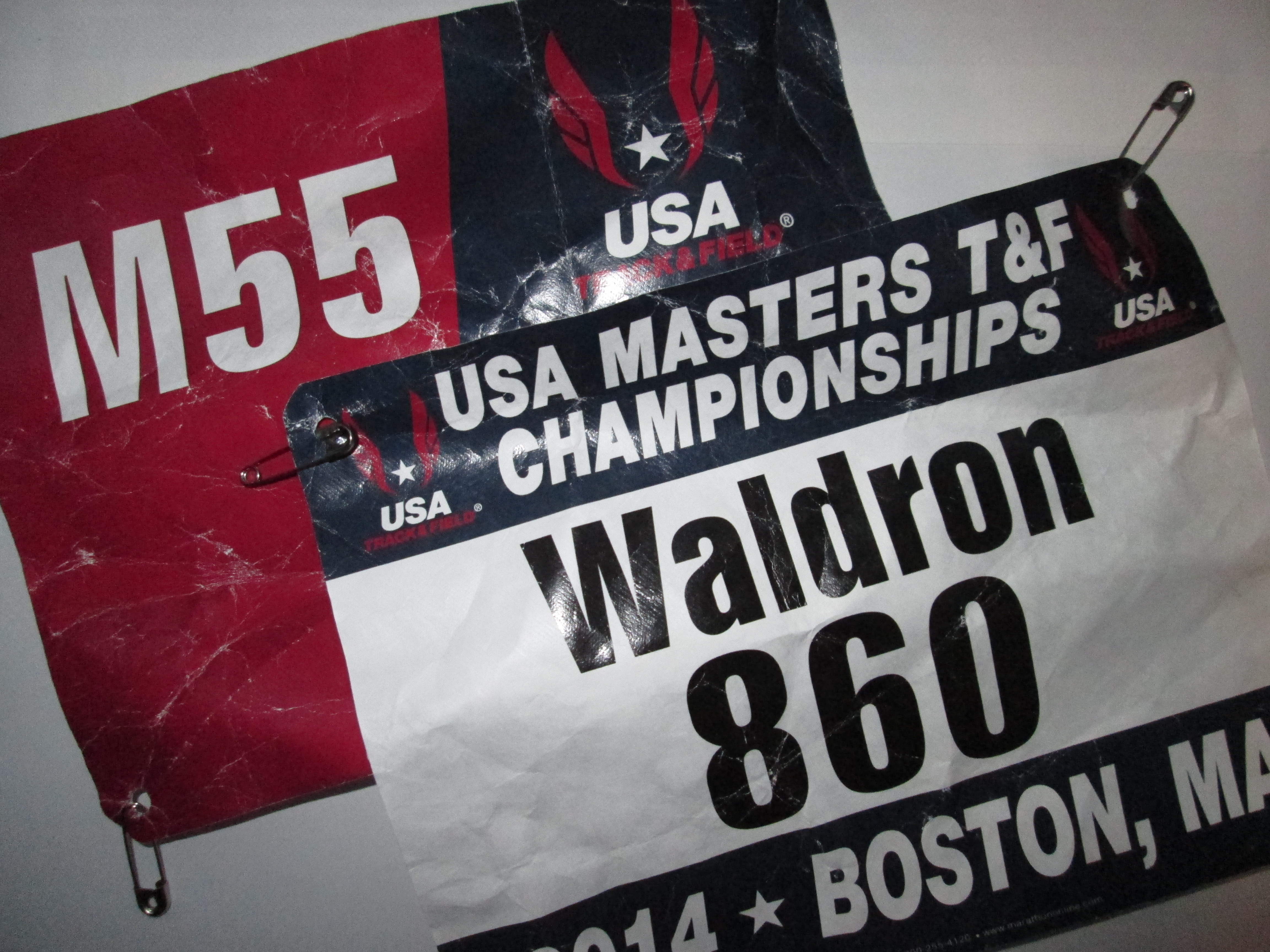
On March 14 and 15, I raced the 3000 and 1 mile at the 2014 National Masters Indoor T&F Championships. On Friday, I had been as nervous as could be for the 3000. After running well and finishing third, I experienced immense relief, and I felt calm and confident going into Saturday’s mile. I thought it would be a tougher race, but it was the race I had prepared to run and I was looking forward to it.

One thing that surprised me then and surprises me still is the importance I attached to finishing in the top three and earning a medal. I’m frankly embarrassed to admit this, and am likely as not to joke about it with family and friend rather than let on that I care. It’s not that the medals are precious in and of themselves. Even in the M55 age group where there’s high participation across events, there was at least one event on Friday in which just “showing up” would have earned someone a medal.

But I couldn’t deny that to me, earning a medal would feel like a kind of validation — a validation, if any were needed, of the time and attention I had given to preparing for the race. I’ve had moments when it seemed a little foolish and more than a little self-indulgent to spend so much time on something so trivial as running in an age-group meet. But at the same time I suspected that the only thing that would make it NOT foolish was to see it through to the end, give it my best shot, and accept the results.

The race

When I put on my spikes and stepped onto the track on Saturday afternoon, I did a short pickup to stretch my legs, and almost immediately felt a burning pain in my right calf muscle. What had seemed like a minor tightness during my warmup, was clearly aggravated by running in the ultra-light spikes I was wearing, spikes that provided no heel support, forcing me to put my weight on the ball of my foot. It was hard to tell whether the pain would get worse or better when I started racing, and it was far too late to do anything about it one way or the other, but for the first time that morning I felt a little bit less than confident.

Thankfully, there was no time to dwell on this. We were called to the start, and my mind went completely, blissfully blank as we were lined up, and then given the command to walk up to the curved line.

The gun set us in motion, and the top seed, Carlstrom, took the lead. I dropped in behind him, and was immediately boxed in by a runner on my right shoulder. Right away, it was obvious that the pace was really slow, and runners were jockeying for position in the second lane, and also behind me. Wood, the silver medalist from the 3k the day before, went to the front and hung there on Carlstrom’s shoulder. I took all of this in, but if I had some thought or reaction to it, I have no memory of that.

My calf hurt quite a bit, but I could run. That was a relief. There was always the possibility that it would cramp up badly later in the race, but I didn’t think that was likely. I found it easy to relegate the pain to the category of a car dashboard light that can be ignored for tens or hundreds of miles. In my case, I only had to ignore it for another 3/4 mile or so. It was no longer an issue.

The first two laps passed by, and I was mildly surprised to see just how slow they had been. We passed the finish line (409 meters) in about 79-80 seconds. It would have been very comfortable, except for the fact that I had someone practically leaning on me the entire time. I tried to stay calm as our shoulders brushed more than once. Overall, I was very conscious of the fact that I couldn’t allow space to open up in front of me, because if I did, the guy on my outside would accelerate and drop into that spot, and I’d be stuck.

The situation resolved itself on the next lap. Wood didn’t like the slow pace, and surged into the lead. Carlstrom covered the move easily, and Wigglesworth and at least one other guys swung around from behind me and on my outside to chase after the leaders. I increased my pace, too, but as smoothly and  gradually as I could. I didn’t feel any sense of urgency or panic. Meanwhile, the guy who had been on my right shoulder slipped back. I don’t know what the leaders ran for the second 400, but I ran about 76-mid and hit the halfway mark at about 2:35-mid.

The next two laps I just tried to work my way up to be in position to kick for a podium finish. At the front, Carlstrom had hit the gas, and was pulling away. I think Wigglesworth was now in second, with Wood and another guy in third and fourth. I was in fifth, a second or two back, but still running within myself. At this point I had one very clear thought about the race: the leader was gone, but everyone else was within reach. I moved into fourth and with two laps to go had contact with Wood in third. The third quarter was 74-high.

For the most part, when I watch a professional running event, I don’t see much that has any applicability to the races I run. But a week earlier I had watched video of Chanelle Price winning the 800m at the World Indoor Championships, and I had been really struck by how she described her approach to the last lap. She had used the word “punch,” as in hitting a particular spot and pushing hard, and had said that she wanted to punch twice over the final 200m. For some reason, this resonated with me, and I had made up my mind that whatever else happened I would try to “punch” twice, once with 350 to go, and then again at 150 to go.

So when I hit the backstretch of the seventh lap, I punched. I went by Wood into third and tried to hold the pace around the far turn and into the homestretch. According to the splits that Stephen Peckiconis was taking, my seventh lap was 36.6. Wigglesworth was running hard, too, and had about 2-3 seconds on me as I swung into the backstretch for the last time.

Punch.

I accelerated again, throwing myself into the final 150 meters, trying to open up my stride without flailing. For a few moments, I thought I would close the gap, but Wigglesworth had been saving something, too, and maintained most of his lead, hitting the finish about a second and a half before I did. According to Stephen’s splits, my last 800 was 2:26, my last 400 was ~71.8, and my last lap was ~35.2 for a final time of 5:02.22.

Carlstrom was the deserving champion, running 4:55.43 in spite of the slow early pace. Wiggleworth took silver in 5:00.76. Behind me, Thomas Sherwood closed fast to take fourth in 5:04, while Wood faded to fifth in 5:07 and Robert Liebers (4th in the 3k the day before) was 6th in 5:08.

Aftermath

With the race over, my right calf completely seized up. I hobbled back over to my stuff and changed out of my spikes and into my flats. After walking a little and concluding that jogging would be premature, I made my way to the infield where the medical staff provided me with a bag of ice, and I sat on the infield and watched the high jump while icing my calf. Later I would try to jog again, but give it up after about a quarter mile. It didn’t seem like a very triumphant finish to the day, but I was satisfied. Maybe I could have run better, but I’d shown up, followed my plan, and I was ready to accept the results.

As for my calf muscle, I was a little annoyed at it, but only because it was a beautiful afternoon, and I would have enjoyed cooling down outside, and maybe the next day going for a long, easy run with no worries or expectations.

I knew my calf would be fine in a few days. And when it had healed, it would be time to go back to the roads for a while. And somewhere in the indeterminate future, maybe I’d start thinking about track again — maybe dreaming of a different colored medal.

Posted in Indoor Track, Race Reports | 1 Comment

Race Report: 2014 Masters Indoor T&F Championships – Part 2 (of 3)

After racing the 3000m Friday afternoon, I felt pretty good about the mile on Saturday. My only complaints were a rawness in my throat left over from breathing in so much dry air during the race and a slight pain in my right calf that didn’t seem especially serious. I felt ready for a decent race, and only wondered who I would be racing the next day.

Handicapping the field

This is what it feels like to be a baby boomer: there were more entrants for the mile among men 55-59 (my age group) than in any other. There were so many that, whereas other age groups were combined to keep the meet moving along, our age group had to be split into two sections to accommodate all of us.

On paper, the race was much more competitive than the 3000m, but in a different way. The top two seeds were Paul Fragua of New Mexico, the 2013 outdoor champion for 55-59 in the 800m, who was seeded at 4:54, and Casey Carlstrom of Ithaca NY, who had only just celebrated his 55th birthday and had run 4:55 in January on a flat track. Both the guys who had beaten me in the 3000 were entered, Fram at 4:56 and Wood at 5:00. Then there were a bunch of other guys who figured to be in the mix, including Henry Wigglesworth seeded at 4:57, Mark Rybinski at 4:59, Michael Mooney at 5:01, among others. I was nestled in there at 4:56.60, but I had run that on BU’s lightning fast track in an evenly paced “time-trial”-like race, and I figured it didn’t mean much for a tactical race.

In Masters track and field, a lot can happen between entering and actually starting. So I shouldn’t have been surprised when what had looked like a really deep field started springing leaks. First, Fram decided that he was satisfied with his one national championship and skipped the mile to rest for the New Bedford Half Marathon on Sunday. Next, the fastest entrant in the race, Fragua, never showed up. So now the field was Carlstrom, me, Wigglesworth, Wood, and Mooney, with times at or just under 5:00, and another half-dozen with times between 5:05 and 5:20. Carlstrom figured to be very strong, and Wood had already beaten me once with a big kick. I felt like I really needed to execute a good race plan to have a chance to medal.

The Specificity of Training

As my CSU teammates know, in February I went AWOL from our usual track workouts and started doing my own thing. What happened was that one day I sat down and really tried to think about what I wanted out of a mile race in March. I was convinced that most championship races are won by the person who closes the fastest. In addition to running a smart race, I felt like I needed to learn how to change pace more effectively when I was tired at the end of a race.

I thought about how I trained, and I decided to make three important changes to the 5k/10k workouts that were the staple of the group:

  1. Work on my basic speed

  2. Work on my ability to change pace, especially when tired

  3. Race more

I wanted to race more because I wanted my mind to be used to mile pace and to think of it as a normal physiological state, rather than as a cause for blind panic. Following this plan, I ran three 1M races and an 800 in five weeks from January 19th to February 23rd (the 800 was the second race of the day at the NE Indoor Championships). Eight days out from the national meet, I also ran a 1000m time trial at faster than mile pace, closing hard. (I had intended to run 1200, but ran my first 400 too fast, so I edited the time trial on the fly to avoid making it an exercise in flailing at the end of a hard effort. Better to run shorter and finish fast than run longer and be slowing down at the end, I reasoned.)

As for changing pace, I tried to be conscious of my mechanics at the end of every interval and especially at the end of every workout. In addition, I did some sessions where I consciously focused the workout on shifting gears.

One workout stands out in my mind: it was about three weeks out from the national meet, and it was probably the hardest workout I did, mentally if not physically. The plan was to run 4 x 800m, with the following 200m splits: 40-40-38-36, in other words, two changes of pace, closing at 4:48 mile pace.

The first interval went pretty much according to plan, although I ran the third 200 a second fast, to hit 2:33. The second one was a little out of control, as I hit splits of 40-40-36-35.5, to hit 2:31.5. After that, even after more than three minutes of rest, I could feel the lactic acid stubbornly refusing to leave my muscles.

I launched into the next one with more hope than determination and hit splits of 40-40-38-18, stopping 100 meters short of 800 as my body started shutting down. On the last one, I decided to run a 600, and it was still bloody hard: 40-39-36, for 1:55. After that, I walked and jogged for nearly seven minutes before doing few quick 150s at the end to remind myself that running fast wasn’t always such a heart-rending process.

After that workout, I was convinced that I could kick, but equally convinced that I had to time the kick properly. I would not have the option of stopping 100m before the finish line in the actual race!

As for mental preparation, I rehearsed and rehearsed in my mind how I would run the race. Regardless of the pace at the front, I would remain relaxed through 800, moving up only if those in front of me were slowing down. I would run the next 400 to put myself in position to kick, and then I would kick.

Saturday Pre-Race

On Saturday, I arrived at Reggie around 11:00, about two and a half hours before my race was scheduled to start. As on the previous day, I found a place to chill out while waiting for it to be time to warm up. I watched the races on the track with a sense of detachment. I was much calmer than I had been the previous afternoon.

When it was time to warm up, I headed outside. The temperature had risen up into the 50s, and a lot of people were out and about, enjoying the nice weather. After a short loop in the neighborhood, I headed over to the track behind Madison Park High School and continued my warmup there. After about twenty minutes, I headed back to Reggie to start dynamic drills and stretching. My right calf was still a bit sore, but I figured I wouldn’t notice it once I started racing.

Finally, at about 1:15, I collected my hip and shoulder numbers and stuck them on. As the section ahead of us got underway, I put on my spikes and headed out onto the track for a few last easy strides.

Posted in Indoor Track, Race Reports | Leave a comment

Race Report: 2014 Masters Indoor T&F Championships – Part 1 (of 3)

It had been six years since my last appearance at the USATF National Masters Indoor Track and Field Championships. In 2008 I had just turned 50 and was looking forward eagerly to competing in my new age group. Unfortunately, in my eagerness to prepare, I had done some stupid things in training and developed a hip flexor injury that ruined my stride and would hamper my running for months. Nevertheless, I ran in the national meet that spring, struggling through the 3000m in 10:01, finishing a discouraging eighth.

When I decided to make the 2014 National Masters Indoor meet the focus of my winter training, it was with the idea of running the mile, which I consider my strongest event. But when the time came to enter, I decided to double, adding the 3000m on Friday afternoon to the mile on Saturday afternoon. I had my reasons, but chief among them was the distant memory of the 2003 meet, when I did the same double and ran my best mile of the season — maybe my best competitive mile ever — just 18 hours after running a fast 3k. One thing I knew about myself is that I would be super nervous for the first race and more relaxed and focused for the second one.

The meet

I arrived at the Reggie Lewis Center in Roxbury a little after 2 p.m. on Friday afternoon. The track was bustling with activity, with a number of events underway. I knew I had plenty of time (my race was scheduled for 4:08), so I took my time picking up my number, putting down my stuff, and trying to stay relaxed before it would be time to start warming up. I took a moment to take in the scene and think about the strange world of Masters track and field.

Meets like these are a unique mixture of world-class athleticism and the ethos of an  all-comers meet at your local high school. Because many of the same athletes show up year after year, the meet feels like a big family reunion. The indoor championships are much smaller than the outdoor championships, and maybe that contributes to the intimate atmosphere (I’ve never been to the outdoor championships).

I take the meet very seriously as one of the few chances I have to experience the intensity of racing in close quarters against actual people, and not against the clock. But not everyone approaches the meet with the same somber determination. There is a lot of fun, and a lot of try-something-for-the-hell-of-it goofiness going on, too. Some of the races in some of the age groups are very competitive, and some are so thin that showing up and finishing guarantees you a medal. It’s all good, though, and only goes to prove that the older you get, the more important just “showing up” becomes.

I had already passed the first and most important test; I had managed to show up, healthy and uninjured.

The 3000m

The entry list for the 3000 Friday afternoon suggested that it might be a lonely experience for me. The top two seeds in the race were Whirlaway’s Craig Fram, who still holds the American Record for the M45 3000m and was seeded at 9:39, and Los Alamos TC’s Blake Wood, who won this event at the 2011 National meet and was seeded at 9:40. I was seeded a distant third with a time of 10:03, and behind me, there was no one under 10:20.

What I really wanted, and what I set my mind to, was to run 40-second laps for the first 2k and then close the last 1000 meters fast enough to go sub-10:00. What I really DIDN’T want to do was go out hard and die, so I figured if Fram and Wood pushed the pace early, I would let them go and run my own race.

When the gun went off, Fram took the lead and — to my surprise — settled into a pace that was exactly what I was hoping for. Later he would tell me that he hadn’t been anywhere near a track for many weeks, and that the moderate pace actually felt fast to him. In any case, he was running 40-point laps like clockwork and I was happy to follow, with Wood on my outside, and 3-4 other runners nipping at our heels. In this arrangement, we went through the first 1k in 3:21.

The pace didn’t vary over the next three laps as Wood took over pacing duties, but the steady tempo did manage to thin the pack, and it was down to four of us as we hit 1600m in 5:21. Seeing the split, or perhaps following his pre-race strategy, Wood began to push the pace, with Fram covering the move immediately. I thought, “here we go,” and prepared to watch them pull away. Then a strange thing happened. They didn’t pull away. The gap that had opened briefly between me and the two leaders closed again. There were only the three of us now, and although we were running 39-second laps, the pace felt manageable as we hit 2k in 6:40 (2nd k in 3:19).

I almost never think that a 3000m race is fun, but that last 1k was pretty close — hard, but completely absorbing. It felt like every one of the last five laps was a little faster, a little more intense, and as much as anyone else watching the race, I was curious to find out how it would end. After another two laps at 39s, we were at 7:58 with 600m to go, and I could start to sense the finish line. Down the backstretch of the next lap, and without deliberation, I suddenly decided it was time to stretch my legs. That’s not just a figure of speech; for the entire race, I felt like I’d been chopping my stride to run so close behind the others, and with 550m left, I had an unbearable urge to stretch out my stride. So I swung out around Fram, and passed him. It felt good. And then I passed Wood, and that felt good, too.

In hindsight, I don’t know whether it was the right thing to do. Stephen Peckiconis, who was watching the race and taking splits, said that he was hoping I would bide my time to the very end since he felt I had better closing speed than the other two. He might be right. But closing speed in a 3k when you have been running for 9+ minutes and closing speed in a mile when you have been running for 4+ minutes are not the same. Both Fram and Wood were distance guys with much better endurance. The pace we were running was not hurting them nearly as much as it was hurting me. I don’t think I “kicked too soon,” because I don’t think I really had much of a kick left. Still, it’s intriguing to wonder what would have happened if the pace had stayed right where it was until the final 200m. I don’t think the result would have been different, but it would have been a different race.

I held the lead for a little over a lap, and then on the final turn of the penultimate lap, Fram roared by, with Wood in hot pursuit. As they charged through the final lap with all the speed they had been saving, I was trying to hold my form together and finish as strongly as I could. Fram would hold his lead to win in 9:49.23, with Wood a half second back in 9:49.79. Although they had blown me away in the last 200, I still felt pretty good about my finish and my race. I ended up running the last 400 in about 76 and the last kilometer in about 3:13 to finish in 9:53.56, a season’s best by more than 10 seconds.

Ten minutes after the race, I was stretching and rehydrating and thinking about the mile.

waldron_fram

Posted in Indoor Track, Race Reports | 3 Comments

The Hay and the Barn

I have no doubt that there are runners in this world who truly enjoy tapering, and who, while they are counting down the days before a big race, feel confident and elated with the knowledge that they have arrived at the important event both supremely fit and shockingly well-rested.

I am not one of them.

For me, the final days of preparation are like an obstacle course in which the object is to avoid all the activities that — for better or worse — are part of normal training. .

During hard training, one’s entire focus is on doing the next intense workout, or the next long run. There’s not a lot of time to worry about actually feeling good, and if you do happen to feel good, you know the feeling will pass soon enough.

But during a taper, if you don’t feel good then you assume something must be wrong. Maybe you didn’t do enough base mileage months ago when you had a chance. Maybe you raced too much, or too little leading up to this point. Maybe you began tapering too soon. Maybe you did the wrong kind of track workouts. With too much time to think, endless questions rush in to fill the vacuum.

During hard training, it’s very satisfying to complete a tough track workout or a grueling tempo.

But during a taper, there’s little satisfaction in performing short, mostly joyless runs that occupy space on the calendar, but otherwise seem devoid of meaning.

The payoff is supposed to  be that you feel great on race day. I wish that were true for me, but mostly feeling “great” is merely the absence of the familiar aches and pains. It’s true that for a few days, at least, I’m able to walk down the stairs in the morning without easing myself from step to step like an old man. Other than that, there aren’t many signs that I’m actually prepared to run faster.

It’s occurred to me that maybe I don’t like to taper because I don’t like to race. But I don’t think that’s right. I don’t think the anxiety I feel about racing is unusual, and I accept that a certain amount of anxiety is the price one pays for caring about how one does. In any case, running without racing is not my preferred way to enjoy the sport.

No, I think I don’t like to taper because it gives me too much time to obsess about things that could still go wrong. I find myself thinking “Please don’t let me catch that nasty stomach bug that’s been going around. Please don’t let me forget my spikes, or lock myself out of my car, or step in a pothole on the way to the track.”

I tend to have a hard time staying in the moment, anyway, without spending every waking moment worrying about things that, however improbable, might happen to derail my intentions. But these last few days and hours before a race, what is there else to do? Other than doubt my preparations or imagine the results of them, I’m not sure how to experience these moments for what they are.

One thing that gives me comfort, though, is that I know there will be relief. Whether it goes well or goes poorly, the race itself is the cure for the melancholy of tapering. In that sense, all of this resting will, finally, bring me that elation I seek, but it will have to wait until I’ve spent the currency I’ve been saving up.

Posted in Uncategorized | Leave a comment

Poll: How Often Should I Post?

I think you’ll agree that I’ve been doing a pretty good job of posting on a M-W-F schedule, but how long before I run out of things to say? And should I post less frequently but spend more time writing and editing the posts I do publish?

Rather than wrestling with this question by myself, I’ve provided a poll where you can express your opinion. Actually, this is just a transparent example to play around with the polling feature, but that doesn’t mean I’m not interested in the results.

Vote early and often!

Posted in Attempts at Humor, Polls | 1 Comment

“I Hate that Guy!”

One of my hobbies is coming up with conversational games that are suitable for long runs or lunches with co-workers (two activities that otherwise have very little in common). In these games, the idea is to define a recognizable and slightly annoying type of person or behavior, and then try to think of as many specific examples as possible.

So far, my greatest contribution to the genre is the game called “Ruining it for the Rest of Us.” The object of RIFTROU is to come up with examples of people who, while technically following the rules, manage to take advantage of them in such a way that the powers-that-be decide to change the rules to make the entire system work less well for everyone.

Let me explain with the original example that prompted RIFTROU:

At my work there is a salad bar that has a wide assortment of veggies, beans, cheeses, prepared foods, and condiments. One of the nice things is that they always have roasted sunflower seeds (I always sprinkle some on my salad). Since salads are priced at 40 cents an ounce, it is technically possible to purchase nothing but roasted sunflower seeds for a price that is probably less than the retail price, or at least less than what it costs to provide them. Should anyone exploit the sunflower seed loophole by arriving at the cashier with a bowl full of seeds, it would surely prompt a change in the salad bar regulations, which would make everyone’s experience a little more burdensome. It would ruin the salad bar experience for the rest of us.

Having defined the category of RIFTROU, one can easily spend many pleasant hours coming up with other examples.

Anyway, I think I’ve come up with another idea, although credit really belongs to Kevin, who has vented about it on many long runs, and Joni, who provided a canonical example.

On the phone the other day, Joni mentioned that she was reading Neil Bascomb’s book “The Perfect Mile,” an excellent account of the assault on the four-minute mile by Roger Bannister, John Landy, and Wes Santee. We agreed that Landy was the most sympathetic — and unlucky — of the three. We both felt that Landy should have broken the barrier first, even though it didn’t seem to be that important to him.

Of course, it was not the Australian Landy, or the American Santee, but the Brit, Bannister, who made history. On May 6, 1954, Bannister, aided by the pacing of his teammates Chris Brasher and Chris Chataway, Bannister covered four laps of the Iffley Road track in 3:59.4. Six weeks later Landy ran 3:58.0 in Finland, but no one remembers that.

Bannister! That guy had it all! Not only was he really fast, he was really smart and he was an exceptional writer who knew how to tell the story of the four-minute in a way that has resonated down the years. After retiring from running, he became a successful neurologist, as well as a Master of Pembroke College, Oxford.

Me: So, Kevin, what do you say about someone like Bannister — world-class runner, honored doctor, distinguished author, and Oxford don?

Kevin: “I hate that guy!”

That’s right, if someone is too good at everything, too successful, too nice, then there’s only one proper response from slugs like us: resentment!

So there’s your challenge, readers. Can you think of other people who are so fast, smart, good-looking, and nice that they inspire us to exclaim “I hate that guy!”

Posted in Attempts at Humor | 1 Comment