4 Seconds to the Good

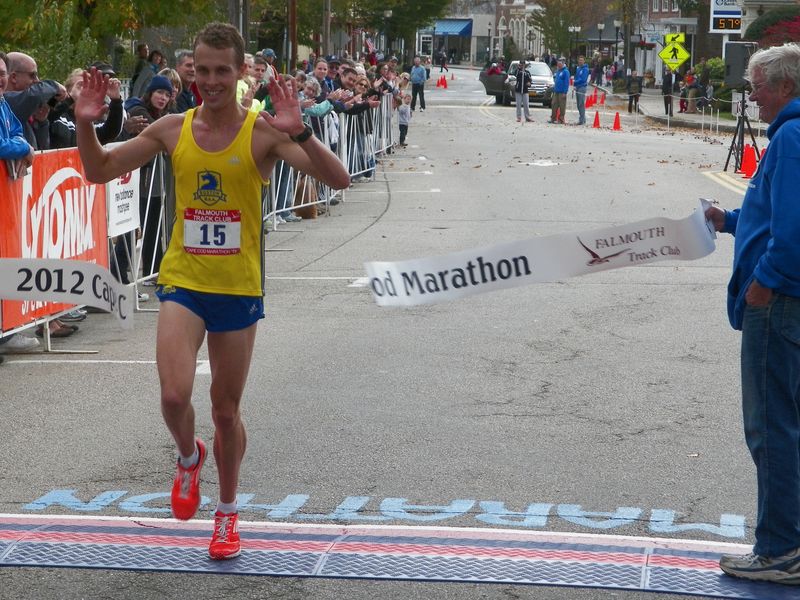
20121028-eric-ashe

“People who hate to lose are not going to go through with a running career because you have to lose and lose and lose to get to a point where you can win, to get to a place where you’ll lose again.” – Tom Derderian

“Athletes must meet the “B” standard (2:18 marathon or 1:05 half marathon) in order to enter the 2016 U.S. Olympic Team Trials – Marathon event.” – USATF Continue reading

Posted in Marathon, Pro Runners | Leave a comment

Taking up Arms

A couple of months ago, the Journal of Experimental Biology published a study that looked at the energy cost of running with various different arm actions.
(The metabolic cost of human running: is swinging the arms worth it?).

The study’s conclusion was hardly earth-shaking. The authors found that running with a typical arm swing uses less energy and results in less torso rotation than running with hands on head, arms crossed over the chest, or arms behind one’s back. Runner’s World published a nice write-up (Arm Swing and Running Economy), but perhaps because the experimental results were non-controversial, the study didn’t generate a whole lot of discussion. I expect many readers felt it was a little silly to conduct extensive experiments to determine that running with your hands on your head is inefficient. Continue reading

Posted in Coaching, Running Research | Tagged , | 1 Comment

From the Archives: Al Oerter

[First published October 4, 2007]

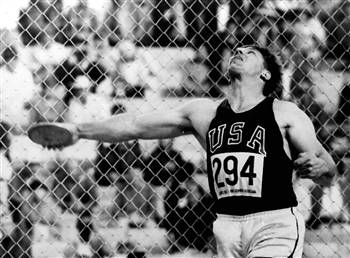
al_oerter

On October 1st, 2007, Al Oerter, four-time Olympic gold medalist in the discus, stepped out of the terrestrial throwing circle for the final time. He was 71 years old.

According to the obituary in the New York Times, Oerter was a high school sprinter turned distance runner (a miler!) when he first picked up a discus that had been thrown by one of his teammates and had landed near him. He tossed it back — farther than it had been thrown originally — and his coach immediately made him a discus thrower.

He first won an Olympic gold medal in 1956 at Melbourne, throwing 184-11, an Olympic record. Four years later in Rome, he threw 194-2, another record.

But what he did in Tokyo was something else again. Six days before the competition, Oerter tore his rib cartilage on his throwing side, causing internal bleeding and severe pain. Team doctors told him to forget the Olympics and to not throw for six weeks. According to the Times, he responded “These are the Olympics… You die before you quit.” He threw 200-1, set another Olympic record and won his third gold medal.

I was ten years old in 1968 when Oerter won his fourth gold medal. He was not considered the favorite, was not the world record holder, but threw 212-6 in the thin air of Mexico City to win his fourth gold medal and set his fourth consecutive Olympic record. I remember thinking that it was amazing how an old guy (he was 32 at the time) could perform so well.

It was 12 years later at age 43 that Oerter, coming out of retirement, threw a lifetime personal best of 227-11 at the 1980 Olympic Trials. He finished fourth, but it didn’t matter. The U.S. team boycotted, so none of the throwers would compete in Moscow. He competed again in 1984, making the finals of the Olympic Trials at the age of 47, but tore a calf muscle before he could take his final three throws. He retired from elite competition after that, but continued to compete in age group meets, and at age 61 was still throwing over 200 feet with a lighter discus (“It feels like a potato chip,” he said).

Oerter was an old school thrower. He believed in taking 60-70 throws in practice, all of them for distance. He was not a great technical innovator, and his technique was perhaps not the best. But he had an incredible work ethic, and his competitive instincts were incomparable.

He also had a full life outside of athletics, as an engineer for Grumman Aircraft and in his later years, improbably, as an abstract artist. He never considered himself a professional athlete, and said, “I’m happy that I had a normal life, with a career and family. That makes a person whole.”

Al Oerter: September 19, 1936 – October 1, 2007

Continue reading

Posted in In Memoriam | Leave a comment

30-year-old Kimetto Sets Marathon WR in Berlin

On Sunday morning in Berlin, Dennis Kimetto and Emmanuel Mutai ran the fastest and second fastest times ever for a record-eligible marathon course. With his astonishing 2:02:57, Kimetto became the first human being in history to run a marathon in under 2:03:00, besting Geoffrey Mutai’s wind-aided 2:03:02 set at Boston in 2011.

It is an astonishing accomplishment for the man who didn’t begin running seriously until his mid-twenties, and was unknown on the world stage until a couple of years ago. The 30-year-old Kimetto now holds the course records at Tokyo, Chicago, and Berlin. Continue reading

Posted in Marathon, Pro Runners, Records & Statistics, Uncategorized | Tagged , , | Leave a comment

Orrery

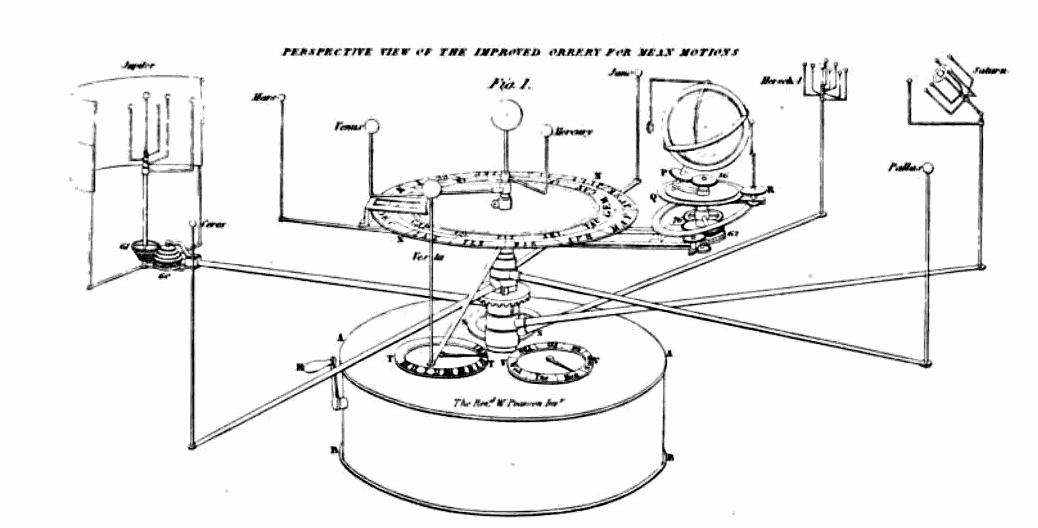
William_Pearson_Orrery_View

“Orrery (noun) – an apparatus showing the relative positions and motions of
bodies in the solar system by balls moved by a clockwork.” – Merriam-Webster

At no time of the year does the daylight flee at a greater rate than now, at the autumnal equinox. With every turn of the earth on its axis, the losses mount — three minutes a day for those of us in Boston. When I come downstairs in the morning and switch on the fluorescent lights in the kitchen, the artificial glow reflecting back at me from the windows only makes the dark outside seem darker. When I finish practice in the afternoon, the sun is almost below the horizon. I shiver to think of the twilight even now overtaking the trails where I’d like to run. Nature’s clockwork is telling me and every other creature, “Take heed, for the day of your life is far spent.” Continue reading

Posted in Weather and Seasons | Tagged , , | 1 Comment

Cloudless Skies

The Chameleons of Concord had home meet yesterday at Great Brook State Park in Carlisle. Great Brook is a beautiful park, and there aren’t too many things nicer than watching cross country there under a cloudless sky on the first full day of Autumn.

We’re not even four weeks into the season but we’ve already had a time trial and two meets. It boggles the mind to think how many of the kids go from relative inactivity over the summer to racing a 5K every week in the fall. Some of the runners, it’s true, trained seriously over the summer. For them, the early meets are tune-ups to get used to racing again. But for the rest, every meet is a new experience and the progression or regression of their times is a matter of great concern.

Yesterday, I had several kids come up to me to ask what was wrong since their time at Great Brook was slower than their time the week before. It’s a reminder that for newbie runners, training is what they did yesterday or perhaps as far back as last week. They expect that good runs/good workouts will translate immediately into faster times in races. It doesn’t matter how often I say that training is a gradual and sometimes frustrating process, the first time they run a couple of races without seeing an improvement it’s a crisis.

We’d all like training and racing to be like that cloudless sky we had yesterday, with no dark masses looming between us and our goals. The sky’s the limit, we say, and we don’t mean the low sullen sky of a late September storm that in a half hour turns the lovely trails of Great Brook into a quagmire.

So today will be the day to talk about races and time, but also long-term training. I will invoke the mystery of low-level cellular changes that have been only just set in motion by a few short weeks of moderate running. I will prepare myself by trying to remember how it all looks to young, enthusiastic runners who haven’t been toiling away at this game for years.

The mills of training grind slowly, but they grind exceedingly fine.

Posted in High School Runners | 1 Comment

My Back Pages: Running to Belchertown

On Sunday, thousands of people walked some or all of the Boston Marathon course as part of the 2014 Boston Marathon Jimmy Fund Walk. In fact, one of the girls on the Concord Academy Cross Country team walked, and her intention was to complete the entire 26.2 miles.

Now perhaps you will judge her for doing such a thing in the middle of a competitive season, or judge me for allowing it, but I should mention that she’s been doing this for several years and is well aware that it will affect her running for a few days or more. In any case, the reason I bring this up is that it reminds me of my own experience participating in a charity walk when I was in high school. Continue reading

Posted in My Back Pages | Leave a comment

From the Archives: Born to Hunt

[ Originally published October 28, 2009]

In Tuesday’s NY Times, an article entitled “The Human Body is Built for Distance”  begins with this rhetorical question:

Does running a marathon push the body further than it is meant to go?

Sometimes, rhetorical questions about running become tedious, and this is one of those times. The trap-door in the question is the word “meant”, which has at least two meanings here. Our bodies might be “meant” to run marathons in the sense that we have certain adaptations that make it possible, even advantageous to go long distances without stopping. On the other hand, it could be that we are not “meant” to run marathons because they’re really hard, and they expose most of us to all sorts of risks and insults.

So, let’s answer the unanswerable question: yes, human beings were meant to run marathons, and no, as a rule, most of us were not meant to run marathons — especially when the entry fees are a hundred bucks or more.

The fact is, some of us do run long distances and are better for it. Most of us do not run long distances, and are glad that marathons are not mandatory. Some of us consider ourselves to be runners, and yet have no need or desire to run longer than a few miles at a time.

However — and I hope you are following my train of thought here — all of us get hungry and need to eat. The most interesting item in the NY Times article was the link to the study, Persistence Hunting by Modern Hunter-Gatherers. In it, the author describes the modern use of endurance running to track and kill game.

I love the term “persistence hunting” and I love the idea that human beings, running in small packs, can out-smart and out-endure animals like the eland, kudu, gemsbok, hartebeest, duiker, steenbok, cheetah, caracal, and African wild cat. Wow. Doesn’t that list, alone, make you want to up your mileage? It turns out, that one of the keys to running down game is chasing them during the hottest part of the day. Humans have a huge advantage in being able to cool themselves via sweating, so all though it’s hot out there for everyone, it’s a lot hotter for the hartebeest.

So I encourage you to skip the Times article and go right to the paper. And when you’re done, instead of picking up Chris McDougall’s book, read “Why We Run” by Berndt Heinrich, which offers a unique mix of anthropology, physiology, biography, and first-person race reporting.

And then meet us at 9:00 a.m. Sunday for our weekly hunt.

Posted in Uncategorized | Leave a comment

Data Driven

Data

I don’t deny that running can be an intensely aesthetic experience.

Some afternoons I’ll be out there on my own, running around Great Meadows at dusk as the last rays of sun make long shadows on the path, and I’ll reach some kind of tentative and temporary communion with my surroundings — the marshes and the river, the geese and the red-wing blackbirds, the scurrying creatures that scuttle away into the reeds along my path and the tiny insects that pepper my eyes and fly into my mouth. If I’m feeling old and achy and broken down, I might not be fully restored by the natural beauty of the scene, but I do find it easier to be content with what I have.

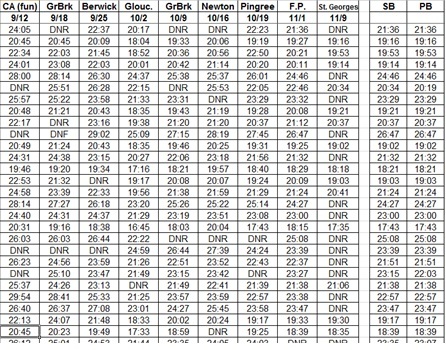
So I understand that my immortal soul owes much to the aesthetics of the sport, but if you really want to know my secret passion in running, it’s not aesthetic, it’s numeric. I just love data and, for me, communing with a spreadsheet full of names and times rivals the pleasure of circling Great Meadows at dusk. Continue reading

Posted in Coaching, High School Runners, Records & Statistics | Leave a comment

Race Report: Lone Gull 10K (9/14/14)

Every weekday afternoon for the last two weeks, I drove past a sandwich board in the center of Concord advertising a local 10K road race scheduled for Sunday, September 14. And every time I saw that sign, my first thought was “Oh, that would be fun…” and my second thought was, “…too bad ‘Lone Gull’ is that day.” ‘Lone Gull’ meant, of course, the Lone Gull 10K in Gloucester, which served as this year’s USATF-NE 10K championship.

Had I ignored Lone Gull and dropped in on the Concord race, I would have likely finished in the top five. At Lone Gull I was 160th, and was fortunate to get that. Continue reading

Posted in Race Reports | 2 Comments