
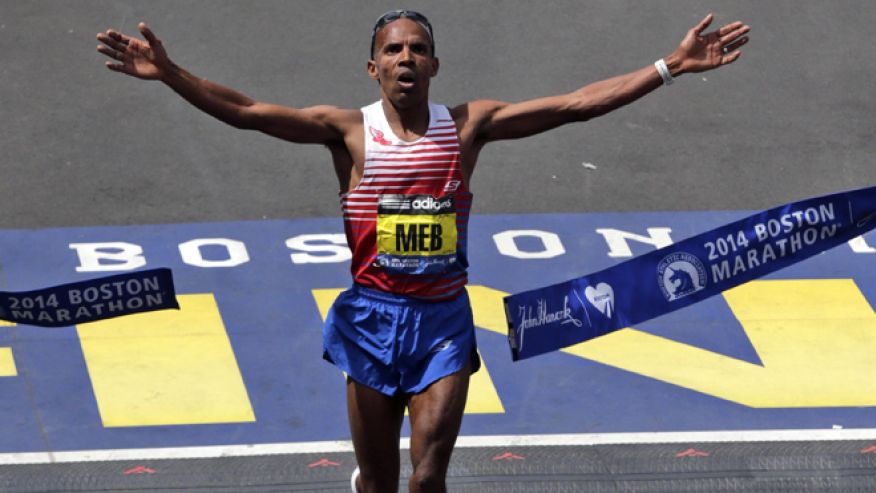
How Meb Won Boston

Meb-KeflezighiMeb Keflezighi’s unexpected victory in the 2014 Boston Marathon was one of the great moments in the history of the race.  Understandably, most of the accounts of his race have been eloquent about Meb’s personal history, his courage in the face of adversity, and his emotional connection to the race and the fans. It truly is an inspiring story and will make a great movie someday.

But how on earth did he do it? How did a 38-year-old runner with a personal best of 2:09:05 and a shoe contract from Skechers beat the deepest field of marathoners ever assembled to run at Boston? How did a lifetime 2:09 guy beat a field that included seven men who had run under 2:05:30, eleven men who had run under 2:08? How is that even possible?

Inspiration and courage played a huge part, but here are five other thoughts about how Meb was able to pull off one of the greatest upsets in Boston history.

1. Boston is not Dubai

Boston is not a flat course like Dubai, Chicago, or Rotterdam. The difference between the top runners and Meb was exaggerated because Meb has run few races on fast, flat courses. Instead, his resume is replete with high finishes in championship races on tougher courses with no official pacemakers.

2. He wasn’t considered a threat to win

Neither I nor anyone I know picked Meb to win. Maybe in the back of my mind I thought he’d run a conservative race and finish in the top five, but win? No way.

Apparently, that’s what the field of sub-2:06 guys thought, as well. Shortly after seven miles and almost by accident, he and Josephat Boit started drifting ahead of the main pack. There was no gauntlet. It wasn’t even a serious move, just a couple of guys with no chance to win expending extra energy. It never occurred to the fast guys in the pack to change their rhythm. They were too busy watching each other and biding their time waiting for the real racing to begin ten miles later. There was no need to worry about a couple of Americans who had never broken 2:09.

3. On real courses, running the course matters

Meb ran the Boston course like he had surveyed every turn, every rise and fall, every pothole in the road. He ran the tangents like every step mattered. Even as he was pulling away, he was scrupulous in using his energy in the most efficient way possible.

If you look at Meb’s splits, he runs the downhills hard (4:37 mile from 15 to 16 down into Newton Lower Falls), and the uphills steady, but not fast (5:12 mile from 20 to 21 up Heartbreak Hill).

In his remarks after the race, Meb mentioned running Boston like it was a cross country course. Meb had read and re-read Bill Rodgers book Marathon Man, and had absorbed the lesson that one must respect the course and run it intelligently.

Meanwhile, the fast guys in the main pack were jogging through the first two-thirds of the course, paying little attention to the tangents and doing nothing to calibrate their pace to the opportunities given by the course.

4. He didn’t panic

When the pack finally kicked it into high gear with eight miles to go, Meb had built a lead of 1:21. With the quality of runners chasing him, that lead was definitely not safe. Even now, I wonder if a runner like Chebet (PR 2:05:27) or one of the other superb distance men had used a more patient, more team-oriented strategy, they could have run Meb down. After all, they had eight miles to do it.

But there was a little bit of panic now, and they had to take chances. Chebet’s splits from 30k to 40k tell the story. He ran 14:57 (4:49 pace) from 30k to 35k, going UP two of the toughest of the Newton Hills. He then ran 14:29 (4:40 pace) for the next 5k. By contrast, Meb ran 15:27 from 30k to 35k, and 15:10 from 35k to 40k. He calibrated his effort to the contours of the course, making more efficient use of his capabilities.

Chebet got within eight seconds with 2k to go. It had been a brave effort, but running the undulating hills so hard had cost him dearly. Watching on the live stream, I thought sure a pass was imminent, but Chebet was cooked and Meb had saved something (or found something), and Chebet never got closer.

5. Being faster is not the same as being better

No marathon is easy. These days, when there are dozens of marathoners running times that would have been unthinkable a few years ago, and predictions abound for new world bests, it’s easy to forget that marathons are designed to be a test of more than speed. In particular, a marathon race is a test of commitment.

There were a lot of faster guys in the race on Monday. They were strong, accomplished runners with an abundance of talent and lots of motivation to do well. On a normal day, in a normal race, you’d think that such talent and such motivation would be enough to finish ahead of even the most courageous runner who lacked such gifts.

But no one ran the race better than Meb. No casual observer — certainly not me — thought Meb could win, but he ran the whole race as though he could win. He committed himself to the race as few people ever do.

The other guys made mistakes. Maybe if they hadn’t made those mistakes there would have been a different outcome, but that ignores the fundamental reason that people race races, and don’t just compare times. Meb won because he was the better runner on the day, the one who made some of the fastest marathoners the world has ever seen look like also-rans.
Posted in Marathon, Pro Runners | Leave a comment

Their Last Boston

Imagine how the young man felt going to the hospital. He was twenty-one years old and not much more than a kid himself, and now he and his wife were about to have a kid of their own. It wasn’t that he was irresponsible; he was a hard worker who had grown up in a family where everyone had to pitch in. Hard work and perseverance came naturally to him and had helped him excel as a high school athlete in football and baseball. After graduation, he joined the military. He had been through boot camp. He could handle tough. But this was different. Maybe it was tougher.

Imagine how the young man felt when he heard that there was something wrong with his son — that his boy had been nearly strangled on the umbilical cord during the birth. It was like a hole opening up in his heart. It would be many months before he and his wife were told how profoundly the lack of oxygen had affected the boy’s brain, and thus his body. He would be incapable of controlling his limbs, incapable of speech, incapable of living life outside an institution. Imagine the darkness he felt when the doctors told him that his son wouldn’t play, learn, live a normal life; told him to give up on the boy.

He and his wife wouldn’t do that. They were both stubborn, and not prone to giving up. They’d find a way to take care of him at home, get him the care he needed, teach him what they could. That was going to take money, so the man worked two and sometimes three full-time jobs, which didn’t leave a lot of time to be home. His wife cared for their son, and then two more sons who followed. There was nothing easy about the life they led.

When his disabled son was 11, the man got some engineers at Tufts to build a device that enabled the kid to spell words using movements of his head. Although ingenious, the device itself wasn’t a miracle; the miracle was that when the kid suddenly had had the means to communicate, it turned he knew a ton about what was going on in the world around him. It turned out the kid was sharp. And funny. Suddenly it seemed possible that the kid might be able to be in regular schools with other kids. The man’s wife now dedicated herself to advocating for her eldest son, getting him access to educational opportunities. This was in the early 1970s and it was an uphill battle.

When the son was 15, he told his dad he wanted to participate in a fund-raising event for a kid in their town who had become paralyzed in an accident. The event was a five-mile road race. The dad, who had never been a runner and probably hadn’t run more than a few steps at a time since boot camp, agreed to push his son in a wheelchair. He suffered badly but quitting wasn’t in his nature and the two of them managed to finish. They were next to last.

The dad peed blood afterwards and felt like he had been through Hell, but the kid loved it. He felt like he and his dad were athletes together. He wanted them to race again. That was in 1977. That was before marathons, triathlons, 45-day runs across the United States, and a life in athletics that crowded out everything else for more than thirty years and made them two of the most recognizable athletes in the world.


2013 was supposed to be the last time.

Dick and Rick Hoyt would run the Boston Marathon one last time and then it would be over. At 72 and 51, father and son had spent the better part of their lives as Team Hoyt — the iconic image of persistence in the face of obstacles so great as to border on the incomprehensible. They hadn’t set out to inspire people, and at first race directors didn’t want them. But something happened to people when they saw the Hoyts competing, something that reached down through layers of complacence and spiritual inertia and changed people’s lives. The Hoyts didn’t set out to be heroes, but when they did their thing, they couldn’t help it; they became heroes for thousands of people.

It didn’t take long for the Hoyts to become a fixture in the world of endurance sports. Over four decades, they competed at over a thousand events ranging from local road races to major marathons to triathlons to a 45-day dash across the United States. As Dick got older, family and friends told him it was too much, worried about his health and the toll that the races took on both of them and on their family. Dick had suffered a minor heart attack, had stents in his arteries, was breaking down — as we all eventually break down.  Now, thirty-six years after that first 5-mile road race in 1977, they had finally decided to wrap it up. They would hear the gun in Hopkinton one last time, roll through Ashland and Framingham and Natick to accept the roar of recognition and love that followed them like a tsunami. It was time to let the crowds see them climbing heartbreak hill for the final time. No one would care that by that point younger, faster runners would be passing on either side offering words of encouragement. And then — God willing — it would be down Beacon Street, through Kenmore Square, and onto Boylston Street hoping that the pain and fatigue wouldn’t keep them from enjoying their poignant farewell to Boston.

But the Hoyts never made it to the finish line. They were among the thousands of runners stopped a mile before the finish. Bombs at the finish turned thousands of storybook endings into chaotic nightmares, and hopes for a triumphant run down Boylston Street were forgotten in the bedlam.


It’s a year later, and along with everyone else the Hoyts are a year older. This really is it for them. Maybe they should have given it up years ago, and maybe its too much to hope that the old man and his middle-aged son are up to it one more time. But whether they meant to or not, the Hoyts became an iconic sight at the Boston Marathon. After what happened last year, how could they not be part of Boston 2014?

I wish for the Hoyts’ sake that they have a good day. I hope the old man gets through it all right. I can hardly imagine the emotions of such a day, but I hope those emotions rise up to make a hard task more bearable, rather than settle down like the weight of the world on shoulders that have pushed a chair through the streets of Boston for more than thirty years, inspiring grown men and women to catch their breath and cry at the outlandish devotion of it all.

Posted in Marathon | 1 Comment

The Spectator’s Dilemma

With only a few days until the Boston Marathon, I’m still not sure how to watch the race. Thinking about that problem, I started thinking about another hard-to-watch event: the Tour de France.

I’m not a cyclist and don’t think of myself as a cycling fan, but when a chemically enhanced Lance Armstrong began winning all those titles in the late 1990s and early 2000s, I became a huge fan of the Tour. On July evenings, I would watch replays of that day’s stage, soaking in the urbane commentary of Paul Sherwin and Phil Liggett. Over time, I began to remember the backgrounds of the individual riders, began to root for or against certain teams, and began to use terms like “peleton,” “attack,” and “breakaway” in everyday conversation.

It was certainly a colorful race then, and I feel more than a little embarrassed to admit that it seemed much more entertaining when everyone was doped to the gills. But that’s not really what I want to talk about.

One thing that I never really understood, though, was the insane fan culture of the Tour. I would see these people lining the road up the side of a mountain knowing that they probably had to wake up at 4 a.m., fight thousands of other motorists to find a precarious parking spot, wait for half the day or more, all for a chance to see the cyclists for a few seconds. I imagine that spending the better part of a day sipping wine, snacking on brie and baguette, and having your brains baked by the hot French sun might well turn you into a lunatic with a need to run alongside the leaders for a few steps, before dropping dead from cardiac arrest.

I would shake my head in disbelief. After all, I was able to sit in front of a TV getting second-by-second information about the leaders, the chase pack, the standings, the king of the mountains, along with a historical overview and architectural highlights of the region — and those spectators were getting what? — a momentary glimpse of the riders followed by hours in a traffic jam getting off the mountain that would make keep them on the road until midnight.

I thought about all that this morning when Ann asked me about my plans for watching Boston on Monday, and I realized that I faced a dilemma not unlike the one faced by anyone wanting to actually watch the Tour de France. The problem is that like the Tour, Boston is actually unwatchable. In its entirety, there’s too much going on, so you have to choose between following the race among the leaders or experiencing the race from the course itself.

Watching in front of a TV without ever raising your voice to cheer on a runner is as lame as it gets. But leaving your living room and staking out a spot on the course to watch for the duration means missing just about everything interesting happening with the elites. Technology and athlete tracking shoud be able to help, but I’ve never managed to figure out how. Maybe this year I’ll be able to stream the TV broadcast to my iPad and have the best of both worlds, but something tells me I’ll still be tuning in to WEEI for quirkily uninformative race updates.

Most likely, Ann, Joni, and I will head over to Comm Ave in Newton. We’ll watch the wheelchair athletes, then the world-class women, then the world-class men go sailing by, so quickly there’s barely time to read the numbers on their chests before they’re disappearing up the road. Slowly — so it seems — the merely elite runners will begin arriving, followed by the very good runers, followed by the serious runners whose accomplishments are known only by their families and training partners, and that will be only the beginning.

Of course this is one of the main differences between the marathon and a professionals-only event like the Tour de France. The tour has about 150 elite riders and no friends and family. Boston is mostly friends and family, as well as strangers who could be long-lost cousins if you dug deeply enough into your mutual genealogy.

Back on the course, an hour will pass. Runners from the second wave will arrive. It will be hard to tear ourselves away, but our hands are raw from clapping and our legs are stiff from standing. And still there will be no letup in the number of runners filing past. Eventually we won’t be able to take it any more, and we’ll head home, extricating ourselves from the crowds. But even as we do so, we note the people holding signs who wait for THEIR runner to arrive.

After it’s all done, after I’ve checked the results to see how my friends have finished, I’ll feel as though — once again — I’ve missed something critical, missed the essence of the event, whatever that is. I wonder, do spectators lining the route of the Tour de France feel the same way?

Maybe the problem is that I identify too much with the runners to ever feel satisfied with watching. Unlike a professional bicycle race where I never expect to understand anything about how it feels to climb Mont Ventoux, maybe with Boston the only way for me to truly see the race is to run it myself. Then, even though I didn’t see the winners cross the line, I would know how they felt.

Maybe the real spectators’ dilemma is that for me on Patriots Day, it sucks to be a spectator.

Posted in Marathon | 1 Comment

From the Archives: Have a Rotten Day

[I got nothing this morning — too busy balancing work and preparing for a track meet this afternoon — so I dug up this story from the archives. No one liked it then, so I assume no one will like it now. But after waking up and seeing snow on the ground for the first time in over a month, I wanted to remind myself that there are advantages to running in bad weather… (Originally Published May 5, 2007]

Last Thursday night I jogged over to Fresh Pond for a short tempo run with my long-time training partner, Terry McNatt. Terry and I typically run track workouts on Tuesday, and on Thursday we do something a little less intense — a tempo run at threshold pace, or sometime a short workout on the hills of Comm Ave in Newton.

It was a beautiful evening on Thursday. Flowers were blooming along the borders of the path and around the public waterworks there. The trees had new young leaves that rocked in the wind and made a rustling sound I haven’t heard for six months. After what seemed like months of cold and rain, it was great to be out in shorts and t-shirt, feeling fast and light. At least, it was great until we started our run.

The problem was that every other citizen in the greater Cambridge Metropolitan area was also at Fresh Pond that night, and each one had brought his or her three tennis-ball chasing golden retrievers, and they all had the same idea of enjoying strolling around the Pond talking on their cell phones. (The owners, not the dogs.)

Where were all these people last month, I wondered. Where were all the dogs all winter? Had they been indoors all this time, and only let out yesterday for the romp of all romps? I tried not to begrudge them access to the whole width of the Fresh Pond path, as I tried to slip by them quietly while running at 5:50 pace and breathing hard. They had every bit as much right to be there as I did, probably more, since theoretically a runner takes up a lot more space than a walker. No, I didn’t mind the traffic, but — and here is the amazing thing — I started thinking with nostalgia about those happy evenings several weeks earlier when Terry and I would meet at The Pond under the shelter of a building entrance, and set off into the rain with the whole path to ourselves.

There’s something very satisfying about being out training in weather that keeps most people indoors. It can be tough to motivate yourself, but once underway, it’s not so bad, and the heat from running keeps you warm. With few pedestrians to dodge, few distractions of any kind, the run becomes very focused and pure.

The warm weather has changed all that. A month ago there was no problem with joggers, and the very few dog walkers were a welcome sight, isolated islands of humanity with whom to exchange a nod or a wave. Now, it’s summertime and the living is easy. Dogs are jumping and the human density on the running paths is high.

It’s the same on the Charles, on Comm Ave., even on the local high school tracks, whose inner lanes fill with good people from all walks (I use the term intentionally) of life from 6 to 9 p.m. every night.

It turns out that finding a place to run fast is a heck of a lot easier when the weather is rotten and forbidding than when it is lovely and inviting. As much as we runners complain about winter in New England, and Spring in New England,… and even Fall in New England, we have it pretty easy compared with running along the Esplanade on a warm summer’s evening. I really hate to admit it, especially after this spring, but rotten days for everything else are actually pretty good days for training. And nice days are a distraction.

Even as I type these words, I hear the sounds of my neighbors talking to friends they have invited over for a cookout. I hear the laughter, the easy conversation, the clink of bottles… I smell food. It seems so inviting, and I have to rouse myself and remember that I have an appointment with a certain 7-mile course.

If only it were 40 degrees and raining!

Posted in Weather and Seasons | 1 Comment

When Did 2:08 Become Slow?

Multiple Choice Quiz:

1. When did we start considering a 2:08 marathon “slow?”

A: 2003
B: 2008
C: 2012
D: April 13, 2014

The 2014 London Marathon is in the books, and as everyone knows by now, multiple Olympic and World 5k and 10k champion Mo Farah struggled home in 8th against what was considered the best marathon field ever assembled.

This has been the year for track champions to take on the marathon in heavily-hyped debuts. In addition to Farah, the greatest female distance runner of all time, Tirunesh Dibaba also made her marathon debut at London, finishing a close third to Edna and Florence Kiplagat. A week ago, Keninisa Bekele debuted at the Paris Marathon and won with a very impressive (and mostly solo) 2:05:00 on a course considered slower than London, Berlin, and Rotterdam.

Whatever you thought of Farah’s chances against the world’s best in the longer distance, you’re probably in good company thinking that Farah’s time of 2:08 :21 just isn’t very fast. But I remember when a 2:08 was fast; when did it become slow?

In 2003, Paul Tergat became the first man to run a marathon in under 2:05. Betraying my advancing years, I have never fully adjusted to this fact. It’s not that 2:04 strikes me as “fast,” it’s that it strikes me as fanciful. If I forget that it represents actual human beings running on actual legs, then I can look at that time without hyperventilating — even make smart-sounding comments about races where multiple people record such times — but it’s all just an abstraction to me. If I really think about how fast that is — for how long — I just don’t believe anyone can do it.

But back to 2003. The other thing that was significant about 2003 is that for the first time there were 50 marathon performances under 2:09 that year. In other words, 2:08s  had become unremarkable to an extent that you could run under 2:09 and not even make the top-50 list. Maybe 2:08 wasn’t yet considered slow, but I think we can agree that 2003 is the year when 2:09 became unworthy of notice.

In 2008, Haile Gebrselassie became the first man to run under 2:04 for a marathon. In that year, there were 50 performances of 2:08:47 or better, many of them by runners whose names are completely unfamiliar to me. Do you remember Gudisa Shentema (2:07:34), Tariku Jufar (2:08:10), or  Tessema Absher (2:08:26)? I Thought not.

In 2012, there were no new world records, but there were 50 performances of 2:07:30 or better, the first time ever that running 2:08:00 would not place you in the top 50 for that calendar year. It might not even get you more than travel money for your next marathon. I think there’s a strong case to be made that 2012 was the year that 2:08 officially became a slow time, at least in the world context. If you were American, a whole different set of standards would have applied. Among Americans, only Dathan Ritzenheim ran faster than 2:09 that year, so 2:08 would still have been fast for an American.

(It’s a little crazy that Meb Keflezhigi’s 2:09:08 win in the 2012 Olympic Trials ranked only 127th overall on the annual lists.)

And then there was Sunday’s race in London, where Farah ran 2:08:21, finished eighth, and was told by David Bedford to give up on the marathon and return to the track where he still has a chance. Imagine thinking you’re a marathoner when you can’t break 2:08!

Posted in Marathon | Leave a comment

Boston 1984 (Part 3 of 3)

???????????????????????????????

“It is good to live and learn.” – Cervantes, Don Quixote.

Everything I wrote in the first two parts of this story, I wrote from memory, without consulting old training logs, accounts of the race, or anything else. But when I sat down to write this final installment, I started wondering about some of the details, and I started looking for the artifacts I had kept that would help me fill in the gaps.

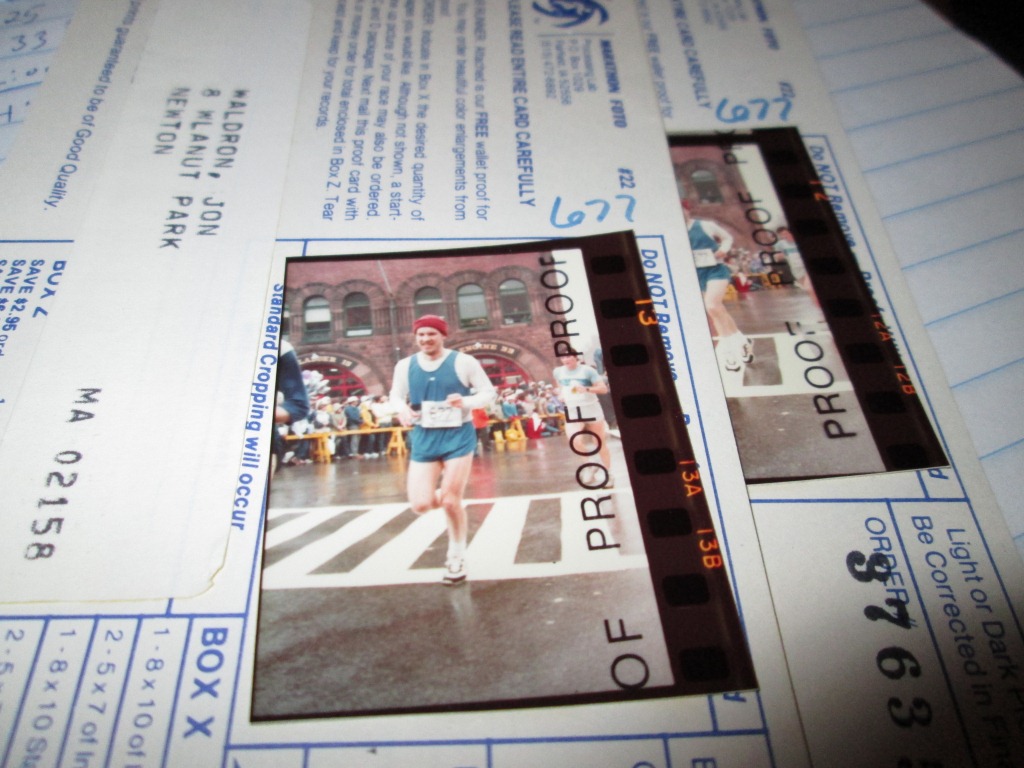
In an old photo album, I found the postcard that the BAA had sent me with my time, my overall place, and my age-group place. I also found the order forms for photos taken by the official race photographers (in those days, they would cut out rectangles from the proof sheets using an xacto knife, and then glue the pictures to an order form, a technique that seems incredibly primitive and labor-intensive now).

One of the proofs looks like it was taken in Newton on Comm Ave. In the picture, I’m the only runner, but in the background are several people holding umbrellas looking away from me, presumably at the next group of runners coming up the road. There are two other proofs, both taken on Boylston Street near the finish line. In both of these two, taken moments apart, I’m gritting my teeth and apparently trying to rally for a final sprint. But even when I recall how bad I felt, I have to admit that there’s nothing alarming in how I look — just another runner finishing a long race. Actually, what strikes me most about these pictures is how young that runner looks; he’s sporting a mustache and his face looks fresh and resilient. As I continue to examine the pictures and try to identify with that kid, my 2014 self begins to feel something like envy towards my 1984 self.


In the days after the 1984 Marathon, my life returned quickly to the normal cares and concerns of a job and a young family. I went back to work the next day, where I avoided stairs and continued to be embarrassed about my race. At work, I discovered how difficult it can be to talk to non-runners about the things that are important to runners. Even in casual conversation, I found it nearly impossible to hide my disappointment, but that was just confusing for my colleagues, who understood that I had run and that I had finished… what else mattered? I began avoiding these conversations, or having started one, found ways to cut it short with some cliché or other.

My running life also recovered, although it took longer and had some setbacks. It took me about a week before I was able to run again, and another week before I could run without my quads complaining. Once the pain had subsided, my desire to run more and faster returned with a vengeance. In May, I made my final mistake of the 1984 Boston Marathon. I began training hard again, way before my body was ready. After a few weeks I had messed up my calves, and would eventually have to take almost a month off to let them heal.

But that too would pass. By the end of that summer, all was well. By that fall, I started racing again with CSU, and I was as enthusiastic about running as ever, with one exception: where there had once been a burning desire to race Boston, there was now a gap. It was like the empty place on a wall where a painting has been taken down.

It’s funny: the next six or seven years would turn out to be the best years of my running life, at least as measured by times and places. Even though I was working hard in the volatile high-tech industry and our family was growing (Loren was born in 1986), running and training became ever-more deeply integrated into my life, and I kept improving.

But it would be seven years before I ran another marathon. I was 25 when I ran my first one, 26 when I ran Boston for the first time, and I would be 33 before I ran it again. Since that race in 1984, and despite having been embedded in an active running culture and living less than two miles from the course, I have run the Boston marathon only three other times. I have never threatened to become a Boston “streaker” — one of those runners who enter the race every year and, when their streak eventually reaches twenty or twenty-five or thirty years, have their stories told in a special pre-marathon section of the Boston Globe.

I think that “learning from experience” is an interesting phrase. It almost implies that once you’ve had the experience, you’ve also done the learning, but I don’t think that’s the case. It seems to me that simply having an experience doesn’t imply what you will or won’t learn from it. When an experience is particularly powerful or traumatic, the learning takes a long time and is a non-linear process that involves changing behaviors and thought patterns, remembering and forgetting, and occasionally getting a new insight. Old experiences are compared with new ones, and sometimes a new experience illuminates aspects of the old experience in a way that completely changes its original meaning.

I don’t know if my reluctance to throw myself back into marathons was because I had physically suffered from my 1984 race, or if the particular type of suffering had revealed something about what I did and didn’t want from running. I would eventually return to the marathon in 1991 and run 2:30 at Huntsville and 2:31 at Boston, but I didn’t consider myself a marathoner then, nor do I consider myself one now.

What, really, did I learn from Boston 1984?

I suppose I learned some practical lessons about preparing for and executing such a race. Over the years, in over a dozen marathons, I’ve never had a positive split of more than a few minutes. Was I too cautious in some of those races? It doesn’t matter; the question doesn’t really interest me.

I think that what I really learned was the very beginning of how to handle and process loss, how to grieve. It sounds so self-centered to put it that way, because I didn’t lose anything or anyone, except, perhaps an idealized version of myself. I hesitate to compare my personal experience of a bad race with others’ experiences losing loved ones. This year especially, it will be impossible to watch the Boston Marathon without thinking of that kind of ultimate loss and the road to recovery.

But maybe being humbled in my single-minded pursuit of a fast time was the necessary first step in becoming aware of other people’s grief. I wonder if that Boston race was a small but crucial point of reference that enabled me to be a more understanding person and a more compassionate mentor.

A couple of years ago, I coached a girl who had a really tough race at our league championships. It was the kind of race that a runner never really forgets. She had such high expectations going into it, took risks and ran harder than she ever had, and almost pulled it off, but faded badly in the final 600 meters and was passed by three other girls in the final 200. She collapsed in the chute, had to be helped to a place where she could recover, throw up, and cry. She had placed sixth — a relatively high finish that guaranteed her the honor of being a league all-star, but of course that didn’t begin to make up for her bitter disappointment. A few days later, we had a chance to really talk about the race, and without premeditation I found myself telling her the story of that Boston 1984 race, reliving it a little bit as I spoke.

I don’t think it made a huge impression, the story of the race I mean. But for perhaps the first time, I felt grateful for having had that experience so many years earlier, for having something other than platitudes to offer her as she began the long process of learning from her grief.


Posted in My Back Pages | 1 Comment

Boston 1984 (Part 2 of 3)

Leading up to the 1984 Boston Marathon, I didn’t have enough experience to know that the worst thing you can do when you’re a couple of weeks out from a race is to start reading random articles in running magazines telling you how to prepare for the big day. With an excess of mental and physical energy as the result of tapering, you are especially vulnerable to other people’s theories and the almost irresistible urge to try new stuff — exercises, stretches, massages, acupuncture treatments, diets for carbo-depleting or loading, different drinks, etc — just when you should be sticking to the routine of what you’ve been doing all along.

I fell victim to the idea — picked up from Runner’s World or some other equally suspect source — that it would be a good idea to do some fast 200s in the week before the race. I didn’t stop to consider that I hadn’t been doing anything fast all winter, nor did I have a clear idea of what I was trying to accomplish. Nevertheless, on the Tuesday before the marathon I went out to a nearby golf course and ran some really quick 200s on grass. I’m sure they were impressive, in their own way. Unfortunately, the next day my hamstrings and quads were really sore, and they remained sore for several days. By Monday, I didn’t feel sore anymore, but those several days had been a huge worry, and had left me feeling oddly disconnected from my body.

That was one mistake.

Another mistake was deciding to wear the lightest possible shoes for the race itself. This decision, perhaps exacerbated by the ill-advised strides and the raw weather (it was cold and drizzly right up to the start), almost certainly compromised my quads, which essentially stopped working after twenty-one miles. This was a specific instance of a more general obsession I had going into the race of running the fastest possible time. I had run 2:36 in my debut and, having trained much harder for this second marathon, I figured I would easily go under 2:30.

But my biggest mistake was failing to appreciate the specific logistics of the start and the first few miles of the race. Simply, I had not realized how crowded it would be. In my mind, I had imagined that I would run at a particular pace, just as in any other race. It always took a few seconds to get up to speed; I knew that. But I didn’t imagine that I would be WALKING, trapped in the middle of a crowd of runners who seemed indifferent to the urgency of getting to Boston as quickly as possible.

You have to remember that the depth of the Boston Marathon in the mid-80s was extraordinary. The qualifying time for open men was 2:50. I had run 2:36, and that time had earned me a bib number in the high 500s. There were a LOT of fast runners in the race, and if I hadn’t been so impatient, I would have let them carry me along at whatever pace they chose. Instead, finding myself shuffling down Route 135 at what felt like 8-minute pace, I panicked, and starting looking for any opening to improve my position. I began darting out and around runners, now accelerating to find a seam in the phalanx, now slowing up to avoid clipping the heels of the runner in front of me. Thus did I spend prodigally the glycogen currency that might have sustained me in my all-too-near hour of need.

With all this pointless jockeying for position, I was still sure that the first mile would be a minute slower than I had hoped to run. Instead, as I passed the clock, I saw that it was just over six minutes. Not so bad, I thought, as I continued weaving around slower runners.


As I was committing suicide by fartlek back in the pack, Geoff Smith was running the race of his life at the front of it. On the TV broadcast, you can see Smith’s arms pumping like a half-miler and his cheeks puffing out white clouds into the cold, dreary April afternoon. Smith, who had finished a heart-breaking second to Rod Dixon in the NYC Marathon the previous fall (after leading until just past the 26-mile mark), would run 2:10 that day, winning by over four minutes. He would win again in 1985 in a much slower time, becoming the last man to win Boston before the prize money era. For Smith, Boston 1984 would turn out to be the high point of his career.

In the women’s race, New Zealand’s Allison Roe, who had held the world’s best before Benoit destroyed it at Boston 1983, went out hard and built up a lead that grew to over a minute against fellow New Zealander Lorraine Moller. I never saw Roe during the race, but for many miles I was running near enough to Moller to see the typical crowd of male runners who used to attach themselves to the lead women. I was still near her at twenty miles, but after that our races would go in opposite directions.


When asked about her lightning fast splits for the early miles after the 1983 race, Joan Benoit had smiled and quipped “What splits?” Unlike her, splits were very much on my mind in 1984, and help explain everything that happened later. After my 6:05 first mile, I sped up a lot. I reached 5 miles in 27:50, meaning that I had run miles 2-5 at about 5:27 per mile pace, sixteen seconds per mile faster than the pace needed to break 2:30. I had no idea at the time, but by five miles, my fate was sealed and the rest of the race was now set to unfold like a Greek tragedy. But I didn’t notice or think about it because, finally, I had running room, and for a few miles, I felt like things were back on track. In this temporary state of grace, I ran through Framingham and then Natick where I noted my 10-mile split of 56:00.

The first time I felt that something wasn’t right was at a point just after 11 miles when it suddenly seemed that the runners around me were pulling away. Although I thought I had been running fairly strongly, suddenly going up a very small hill, I felt like I had to work quite hard to maintain my place in the pack. In fact, I was starting to slow down, and I had a long way to go.

I passed halfway in 1:14:15, and made my way through Wellesley, but as I descended the long hill into Newton Lower Falls, I began to experience sharp stabs of pain in my quads. My stride was starting to deteriorate, and, as a consequence, I was using more and more energy to less and less advantage. Having bottomed out on the course, I passed 16 miles in 1:31, and from the way I felt running up the modest hill up and over Route 128, I knew without a doubt that I was in big trouble.

My family had come to Boston to watch me, and like so many other friends and relatives, had chosen a viewing place near the Woodland T Stop that would allow them to watch me go by, and then meet me at the finish. As I passed Newton Wellesley Hospital, I began scanning the faces in the crowd. Suddenly I saw my brother Jeff, and yelled out his name. He saw me and yelled out my name, and then I was past him. I had meant to say so much more, to let him know that I was falling apart, but even if there had been time to say something, I doubt I could have come up with the words to express the certain knowledge I had that these were the early stages of breaking down completely.

After I passed my family, I focused all of my thoughts on getting up and over the Newton Hills. For me, that was the farthest point on my mental horizon. I simply couldn’t imagine anything beyond the crest of these hills. The hills, I felt, were finite. Each one hurt a little bit more than the last, but I was still maintaining the semblance of a running stride, and my quads didn’t hurt so much going uphill. I passed 20 miles in 1:55:20, and threw what was left of my reserves into getting up and over Heartbreak.


In the TV broadcast, the stationery cameras on the Boston College side of Heartbreak Hill show Lorraine Moller motoring along on her way to catching Allison Roe and winning the race. The fast-starting Roe would suffer hamstring cramps at 24 miles and wouldn’t finish. That race pretty much marked the end of her competitive career.

After Moller passes, the camera remains on the road and just before the broadcast switches to the Men’s leaders, you can see me come into view wearing a red knit cap against the cold and running gingerly down the gentle incline grimacing with every step. The first time I saw that footage, I remember thinking that it was a pity the race hadn’t been 22 miles instead of 26.2. I’m not the first person to have had that thought.

I stopped and walked for the first time at 22 miles, just before Cleveland Circle. As I write those words, I can’t really remember all that I was feeling at that point. If there’s a memory in my brain somewhere, it seems to be locked away to prevent unauthorized access. I know that I was disappointed and I know that I was embarrassed because so many people were passing me (such a lot of people passed me that day). I remember that people in the crowd kept trying to get me to start running, and that I did try to start running, and hated those people. Why wouldn’t they leave me alone? I remember taking orange slices from kids and seeing their eyes go wide. Did I really look that bad? I remember that those last four miles took a long time… about 34 minutes, in fact.

After it was all over, after I had finished in 2:41:44 and had been wrapped in a space blanket, I managed to find my way from the finish to the Prudential Parking garage where my family and I had arranged to meet. My memory of those twenty minutes after crossing the line is completely blank. I simply have no recollection of what happened. The next thing I remember is my family standing around awkwardly while I sat against a wall and wept from exhaustion and disappointment. I had tried so hard and for so long, that I just didn’t have anything left to keep back the tears.

Posted in My Back Pages | Tagged , | 2 Comments

Boston 1984 (Part 1 of 3)

If nostalgia is defined as a wistful or sentimental desire to relive the past, then no, I’m not nostalgic about my first time running the Boston Marathon. At the risk of understatement, it wasn’t an easy race for me. But thirty years on and watching all the preparations for the 2014 race, I’ve been thinking a lot about that cold, wet April day in 1984 and how it changed the whole trajectory of my running career, and changed me in other ways, too.

It’s surprising when I think back to those days and realize that I was already entering my second marathon even though I had been back running for only a year or so. Of course, I had run a lot in high school; track and cross country had meant the world to me, then. But after graduation I soon  turned my attention to other things and left competitive running behind. It would be nearly seven years before I took it up again.

It wasn’t until late 1982, the year that Ann and I graduated from college and moved to our little apartment on Gordon Road in Brighton, that I started running again with any consistency. I had gotten my first real job working at a small electronics company in the Fort Point Channel area. One of my colleagues there was in the habit of running at lunch almost every day, and I started joining her for four-mile circuits of South Boston. I found the routine easy and agreeable.

In early 1983, Ann brought me a flyer for a 7-mile road race that would start and finish a block from our apartment. It seemed very exciting, and so I entered the race and put a crude calendar on the refrigerator to keep track of my daily runs. With five weeks to train for the race, I started doing longer runs on the weekend by myself. My cardiovascular system responded quickly to this training, and I noticed that I was doing all my runs a lot faster. Meanwhile, my colleague at the electronics firm had left the company, and I was now doing my lunchtime runs alone, heading down to South Boston, running along the ocean and out around Castle Island.

That first road race started and finished at the East End House on Allston Road in Brighton, with most of the course along the Charles River. I don’t know how I managed to pace myself, but the race went well. Although I finished several minutes behind the winner (a professional looking runner with a Saucony Racing Team singlet), I managed to crack the top ten, which seemed quite good to me. I think Ann expected that after this one race, the whole running thing would be out of my system, but of course it had the opposite effect. I couldn’t wait to race again.

I was also becoming more aware of what was happening in the wider world of road racing. I remember meeting Ann in Coolidge Corner to watch the 1983 Boston Marathon. 1983 was the year that Greg Meyer won in 2:09:00 (the last American to win Boston), and Joan Benoit ran a world best time of 2:22:43. The sight of Meyer and Benoit and all the other runners streaming down Beacon Street toward the finish at the Prudential was unforgettable and inspiring, and in a moment I had resolved to be part of the race the next year.

Running aside, the months that followed were an incredible time in our lives marked by a series of life-changing events over a very short time period. In July, I switched jobs and started working as a technical writer at a small but influential software company, a choice that would define the next twenty years of my career. In August, Ann and I were married. That fall we moved to an apartment in Newton. On January 4th, 1984, Joni was born.

And through this time, I kept running. I ran the morning of our wedding and on our honeymoon, getting up early so that I would be returning from my run when Ann was getting up. My runs got longer. My weekly mileage got higher. I was just making it up as I went along, but it was working for me. That fall I entered my first marathon, the long-since-forgotten Bostonfest Marathon that started and finished at Boston Common with loops out Storrow Drive and down past Jamaica Plain and the Arboretum. I was fairly terrified of the distance, and ran cautiously in the beginning. This turned out to be a good strategy, and in spite of my inexperience, I managed not to blow up much.  Although wobbly-legged and dehydrated from not drinking enough during the race, I crossed the line in 2:36:00, well under the qualifying time needed to enter the Boston Marathon in the spring. I was elated.

When Joni arrived in January, I half expected that it would be the end of my running. I had no clue what it would mean to take care of a baby, but I knew that everything might change, including having the time to indulge my running hobby. A few days after Joni was born, I went for my first run since we had brought her home from the hospital. I remember the feeling of astonishment and relief that it was still possible to do such a thing. Now, thirty years later, it tickles me to think that Joni is the real marathoner in the family.

As I became more accustomed to being a dad, I also got back into training for Boston, and I started looking for opportunities to train with others similarly obsessed. At some point that winter I heard about a running club that did indoor track workouts at MIT, and that led me to join the Cambridge Sports Union. I did my first race for the club in February 1984 at the Amherst 10-miler, running around 54 minutes. A few weeks later, I ran the Boylston 30K and finished 4th overall, averaging about 5:30 per mile for 18.6 hilly miles. I didn’t know it then, but running that race five weeks before Boston was probably the first of a series of serious mistakes that would doom my marathon effort.

Posted in My Back Pages | Tagged , | 1 Comment

My Personal Decathlon

Outdoor track season continues, which means my afternoons are a series of frantic attempts to attend to each and every one of the different events that comprise a high school meet. On a typical day, one of my assistants sends the distance runners on their way, another takes the hurdlers, and I go with the throwers because today we will work on javelin and — if we have time — discus. I am tortured by the fact that I haven’t spent any time this week on long and triple jump. Maybe tomorrow, after we work on relay exchanges.

The funny thing is that there are days when I actually start thinking like a sprinter, or jumper, or thrower. On those days, I have this crazy idea that it would be fun to try a multi-event some day.

If you’ve run with me more than a few times, we’ve probably talked about the “personal decathlon.” The idea is that if you choose them carefully, you can choose ten “events” that are so well suited to your particular talents and abilities that in a competition with the rest of the seven billion humans on planet Earth, you would win.

It’s a lot of fun to ponder which events give you the best chance to win. Of course, you don’t need to be the best in any of them, you just need to be pretty good in all of them, and to choose events that make it virtually impossible for anyone else in the world to beat you when all of the events are aggregated. Can you swim? According to unreliable Internet statistics, 54% of the world’s population can’t swim, so that effectively eliminates more than 3.5 billion people. On the other hand, it still leaves more than 3 billion people! Maybe it would be better to think about what you can do better than 95% of the world’s population. Find ten such events with little overlap between them, and (if my math isn’t too far off), you might be the best in the world in your personal version of the decathlon!

Ok, so what does my PD look like? Well, let’s start with a long-distance race of some  kind — make it long enough to weed out most of the young, naturally talented kids with no training — let’s say a 10K. That’s an easy choice. But after that…

My second event will be chess. I’m not sure how to translate chess prowess into a numerical score, but I think that problem can be solved. And although I’m nowhere near an expert, I’m fairly certain I’m better than 95% of the world’s population.

My third event will involve composing limericks.

My fourth event will be miniature golf. No, scratch that — I’m not that good, and I’ll bet a lot of people who have never tried it would pick it up really quickly. On the other hand, it would certainly make the whole event more light-hearted. Let’s leave it in.

At the end of the first day, the final event will be throwing small balls or crab apples at targets of some sort (my first thought was to use cats as targets, in honor of my father who loved this sport, but in the end I decided not to incur the wrath of my spouse and PETA). I include this event because I want to believe that all those summers when I did little else were not entirely wasted.

Day 2 begins with another running event — a predicted time run. The event will be conducted without watches and the object is to run a fixed distance (say 400 meters) as close to a predicted time as possible.

My sixth event will be speed-“spreadsheeting” — given Microsoft Excel and a problem to be determined by the judges (for example, calculating scores and tabulating results of a decathlon), create a spreadsheet to do it, using conditional formatting, lookup functions, and cell protection. I think after this event, I’ll have an insurmountable lead, but just in case…

Event 7 — Sudoku?

Event 8 — Juggling?

Event 9 — Spelling bee?

Deciding on the final event is not easy. I’m tempted to throw in one more running event, but I worry that by doing so, I would be vulnerable against all the good runners out there, one of whom might just be a chess-playing, sudoku-solving geek like me. It occurs to me that the only true way to ensure victory is to allow each competitor to choose the tenth event ad hoc, after seeing what your competitors can and can’t do.

But I know that’s a dodge. Alright, here goes. The tenth and final event will be commuting — I spend so much of my life getting from home to work to school to work to track to home by every possible means of transportation that surely this would put me over the top.

What events would you put in YOUR personal decathlon?

Posted in Uncategorized | 4 Comments

Early April Workout

It’s Tuesday night and I’m driving to Harvard for our first outdoor track workout of the Spring. It’s almost 6:30 and I’m annoyed at myself for being late. I’m also burdened by the feeling that my day should be over by now. I’ve been up since 5:30, spent a full “day” at work before heading over to the school to coach for another two and a half hours. The thought of heading home to dinner is dangerously appealing right now, and the thought of doing a track workout instead does little to change that. My solution is not to think about either, but to put my mind in neutral, listen to the radio, and follow the same route to Cambridge that I’ve been taking for over a decade.

It might not sound like it, but this semi-annual shift of the major workout from one weeknight to another is a big deal for me. All of the rhythms of the training microcycle are affected, from how fatigued I expect to feel on different days, to how much mileage I get in on the “off” days. If Tuesday track is here, can Thursday tempo be far behind?

We are lucky tonight. April seems to have brought mild weather — finally! March was a bear with its relentless cold and, at the end, four inches of rain in three days. But now as I approach Harvard stadium, my car thermometer tells me the temperature is a very reasonable 47 degrees, and there’s still plenty of daylight left. There’s no guarantee it will continue, of course. April nights can be pretty miserable, too, and next week it might be 40 degrees and raining. But for tonight, at least, it’s a pleasure to be outdoors and not feel the death-like grip of winter.

The nice weather has also brought a lot of other people to the track. CSU is one of four organized groups using the track, along with the Liberty Track Club, New Balance, and TMIRCE (“The most informal running club ever”). On an eight-lane track, there’s plenty of room for all, and it’s actually good to see all these strangers, some of them familiar from years past.

Because I arrived late, I’m still warming up while everyone else is doing their dynamic drills, and as a result, I’m still feeling heavy and slow when its time to start the first interval. Normally, I would do four strides prior to launching into something fast, but I haven’t had time to do strides, so instead I just run the first 400m very slowly, lagging far behind the pack. It will get better, but overall, tonight will be about slogging through, and not about feeling speedy.

On the track and with the workout underway, our group finds itself dealing with new mental challenges compared to indoor. Used to the 200-meter oval at BU, we struggle to visualize the 600s and 1000s in tonight’s workout. We take note of the wind direction, and where to start our intervals to have the wind behind us more than it’s in our faces. Since tonight’s workout calls for a 1600, we are grateful that its only four laps and not eight. We wear gloves. We “race” to finish before the light fades and we can no longer read the splits from our watches.

I admire the fitness of my teammates. Kevin, Patrick, and Terry are all running Boston and all handle 5600m of intervals with, if not ease, then with well-earned confidence. On every longer interval they leave me far behind. They are all running Boston. That means that what to me is the beginning of outdoor track is for them the final steps of their long journey to fitness that began months ago. This outdoor session in good weather is the reward for having survived the long winter.

But for me, this is simply about keeping up a habit as I try to rebuild mileage. I’m not sure that the next few track workout will make me fitter, but they should help me avoid losing the fitness I have. Come to think of it, that’s been the theme of almost all my runs lately.

We finish the workout with one final 400. Then we cool down, heading out around the perimeter of Harvard’s domain, around softball fields, parking lots, and turf fields used for soccer and lacrosse. When we get back, it’s getting dark.  As it almost always happens, I seem to have more energy now than when I started , although my legs are achey and will need stretching and rolling when I get home.

Another workout. Another day of the week. Another season. What was I thinking blogging about this? Do I blog about taking out the trash?

It’s just something that needs to be done. Nothing to write home about.


Posted in Weather and Seasons | Leave a comment