Anatomy of an Injury (Part 1 of 3: “I Got This”)

I’ve never been very good at asking for help in any area of my life, and seeking care for running injuries is no exception. Like many runners, I live in a semi-permanent state of denial about my aches and pains, making half-efforts to manage them, but without ever really giving them my full attention, perhaps afraid that if I do, I’ll have to actually change my behavior. As Don Sutherland’s Bill Bowerman famously remarked to Billy Crudup’s Steve Prefontaine (in “Without Limits”), “It hurts to change, doesn’t it Pre?Continue reading

Posted in Injuries & Health | Leave a comment

Garrett O’Toole Runs 4:01.89

garrett2

Last night at Emerson Track in Concord, Middlesex School senior Garrett O’Toole ran a full mile in 4:01.89, breaking Andy Powell’s 16-year-old Massachusetts High School record and becoming the 14th fastest U.S. prep miler of all time. Continue reading

Posted in High School Runners, Race Reports | Leave a comment

Thursday June 5th is the Adrian Martinez Classic

uceny

No essay today, just a reminder that Thursday evening, June 5th, 2014 Emerson Track in Concord hosts the 6th annual Adrian Martinez classic, a festival of distance races for all levels.

Is this meet worth your while? YES!! The elite events (5000, 800, and Mile) are STACKED with talent. The Men’s Mile features Olympic silver medalist Leo Manzano, fresh off his victory in the International Mile at the Prefontaine Classic, plus NCAA 1000m record holder and 3:38 man for 1500m, BU’s Rich Peters and four other sub-4:00 guys. Continue reading

Posted in Pro Runners | Leave a comment

At the NBB Twilight Meet

It was a good weekend to be a Track fan. On Friday night and Saturday afternoon, USATF.tv and NBC provided coverage of the Prefontaine Classic from Hayward Field in Eugene, Oregon. The Prefontaine meet has become one of the best professional track meets in the world, and the 2014 edition lived up to that reputation. If you were paying attention to high school track, this weekend Massachusetts public schools were competing in the State Divisional Championships, arguably the biggest meets of the year.

And if you were so inclined, you could also take in the third of four high-performance Twilight mini-meets hosted by New Balance Boston. Continue reading

Posted in Uncategorized | Leave a comment

To the Class of 2014

Thank you, President Smith, Dean Jones, Distinguished Faculty, Parents, Relatives, Friends, and of course — those in whose honor we gather here today — Members of the Class of 2014. Today, we celebrate what you have accomplished and look ahead to so much more that you will accomplish in the future. Congratulations to all of you. This is your day!

During this season of graduation and reflection, I’d like to address my remarks to all of the young runners among you, those who intend to continue running and racing, and those who now leave competitive running behind. Continue reading

Posted in Uncategorized | Leave a comment

Suggestions for the Next World Relays

golden_baton

The IAAF deserves credit for innovating with the inaugural World Relays, a two-day track meet held last weekend in Nassau, The Bahamas that was attended by teams from about 30 countries. There’s nothing wrong with trying something new, and the format of this meet was definitely new, consisting of five relay events each for men and women. According to LetsRun’s coverage, the meet attracted large crowds and created a great atmosphere. From what I can tell by viewing video clips of the events after the fact, the races were exciting.

So it probably seems pedantic of me to point out all the things I found puzzling about the meet. But then again, why not. It’s not as though I’ll hurt anyone’s feelings through this blog, so here goes: four suggestions — from the perspective of a high school coach — for improving World Relays.

1. Include the rest of the sport

In almost any team track meet at almost any level, from middle school to the Olympics, there are two canonical relays: the 4×100 and the 4×400. At championship meets, it’s not uncommon to have other events, for example the 4×200 or 4×800. And then there are relay carnivals and meets with the word “Relays” in their title. At these meets, a wide variety of relay events are common, including medley relays (including legs of unequal distances), shuttle hurdle relays, and field event “relays,” in which individual marks from team members are totaled to produce a team score.

World Relays limited itself to five events: 4×100, 4×200, 4×400, 4×800, and 4×1500. I guess if this was a prototype, it’s OK that they left out so many potential events, but if I were a hurdler, jumper, or hurdler, I think I’d be miffed.

High school relay meets regularly include the sprint medley (400-200-200-800), distance medley (1200-400-800-1600), shuttle hurdles, and field event relays. Why not here, as well?

2. Rethink the 4×1500

With only five events, you wouldn’t think one of them would be unorthodox, but what else can you call the 4×1500 relay? The race begins at the common starting line, but because each leg is 3 3/4 laps, the baton exchanges occur at the “corners” of the track. The unfamiliarity of the athletes with the exchange zones and protocol surely contributed to the really spectacular collision between the US’s Katie Mackey and Australia’s Zoe Buckman, as the latter remained in lane 2 after passing the baton to a teammate.

Wouldn’t it make more sense to have a 4×1600 instead?

One could argue that the 1600 is not an event at all, so having a 4×1600 would be strange. But having a distance leg end at the 300-meter mark of the track just seems way stranger to me.

3. Use a different scoring system

Individual relay teams had big cash incentives to win and set records, and that was great. But there was also a team (country) competition for the “golden baton” (see photo above), with points being awarded in every event. The US won this competition handily, and the US women in particular were dominant, winning 4 of the 5 events and finishing 2nd in the other one.

But the way points were distributed was a bit bizarre. It was 8 points for first, 7 for second, etc., all the way down to 1 point for 8th. No meet I’ve ever heard of uses such a flat scoring system that makes so little distinction between first and second. Also, points were awarded regardless of how many countries competed in the event. So Romania scored 5 points for finishing last in the women’s 4×1500 because there were only four countries entered.

It seems to me there’s an obvious fix: use a more common scoring system of 10-8-6-4-2-1. This would assign a higher value to top finishes, and would decrease the value of finishing last in an incomplete field.

4. Consider a three-turn stagger for the 4×200

The 4×200 was run entirely in lanes for the full 800 meters of the race. That makes for safer handoffs, for sure. But it also means that it’s pretty difficult to tell who’s ahead for the first 3/4 of the race. Also, it removes the incentive of getting the pole position after the third leg. Maybe at this level, it’s just too dangerous to have sprinters navigating a chaotic exchange zone, running on each other’s shoulders, cutting in too soon, but boy it would be exciting.

Do all these things, and I promise I’ll actually watch the meet next year.

Posted in Pro Runners | 2 Comments

What’s Reasonable vs. What’s Possible

Tyler_vcm_sidePhoto: Brian Jenkins for the Burlington Free Press

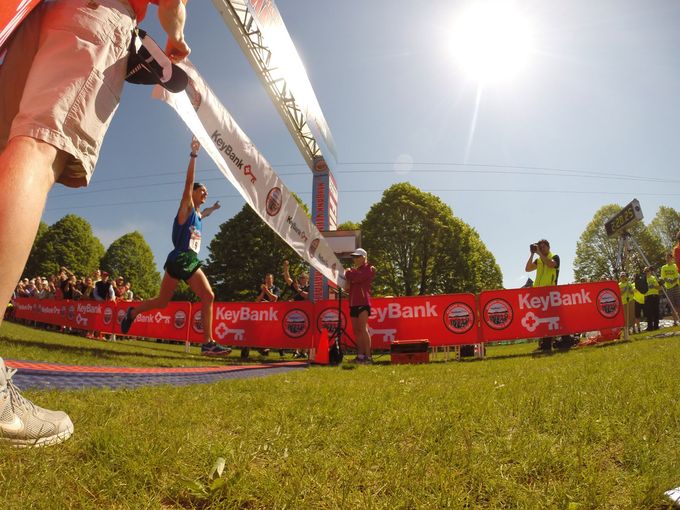
While Tyler was running his marathon in Vermont, I was four hours away sitting comfortably in a coffee shop in Concord, waiting for updates via text message. I had signed up for athlete tracking on the race website, hoping that this would enable me to follow his progress. But unlike in Boston, which had timing mats every 5k, Vermont City had mats only at the 10k, 10M, half marathon, and 20M, and I never did get the 10M split. That meant that I had long periods to wait in between updates, and nothing at all after 20M. Continue reading

Posted in Coaching, Marathon, Training | 2 Comments

Wild Mice Like Wheels, Too

mice_on_treadmills

Apparently, if you set it up, they will run.

“A pair of researchers in the Netherlands has found that if a running wheel is placed outdoors in a natural setting, wild animals will come and run on it…. Scientists, researchers and animal rights advocates have argued over the years about the nature of mice running on wheels in their cages. Rights activists claim the running is a form or neurotic behavior brought about by living in the confines of a small cage. Some researchers, on the other hand, have suggested that the mice seemed to like, or enjoy running on the wheel, and even exhibited unhappy behavior if a wheel was removed.”

Read more at: http://phys.org/news/2014-05-animals-wild-wheel-choice-video.html
Continue reading

Posted in Uncategorized | 1 Comment

A Little Training Lesson

“I was involved in an unusual experiment on one of my trips to the United States. A number of schizophrenic patients of the University of Wisconsin Outpatient Psychiatry Clinic, most of whom were suffering from depression, were started on a jogging program and, at the end of ten weeks, 75% of them had recovered from their depression. The goal of their therapy was simple: they were taught stretching before and after running, and then filled 30-45 minutes with comfortable movement – not to cover a particular distance at a set pace, just to jog. Continue reading

Posted in Injuries & Health, Training | Leave a comment

The Coach as Teacher

The last remnants of the sunset were fading from the sky as I drove South on the Maine Turnpike Saturday evening. It had been a long day at the end of a long track season, and I was at the wheel of a school mini-bus, driving my team the two-and-a-half hours back to Concord after our final meet, which had been hosted by the Hyde School in Bath. True to form for the spring of 2014 it had rained much of the day. Continue reading

Posted in Coaching, High School Runners | 1 Comment